Quick Answer: What to Do if a Tree Falls in a Storm
If a tree has just come down on your property in Bournemouth, follow these five steps in order:
- Check everyone is safe — keep clear of fallen trees, especially near power lines. If anyone is hurt or there’s a live cable, ring 999.
- Photograph the damage before anyone touches it — your insurer will want evidence.
- Ring your buildings insurance provider to start the claim and get advice on emergency repairs.
- Report fallen trees on public land to BCP Council via their Report It function.
- Call a qualified emergency tree surgeon to make the area safe and remove the tree properly.
Below, we’ll walk you through each step in detail — including who pays, what your insurance covers, and how to avoid common mistakes that get claims rejected.
A Tree’s Down — Take a Breath, Here’s What Happens Next
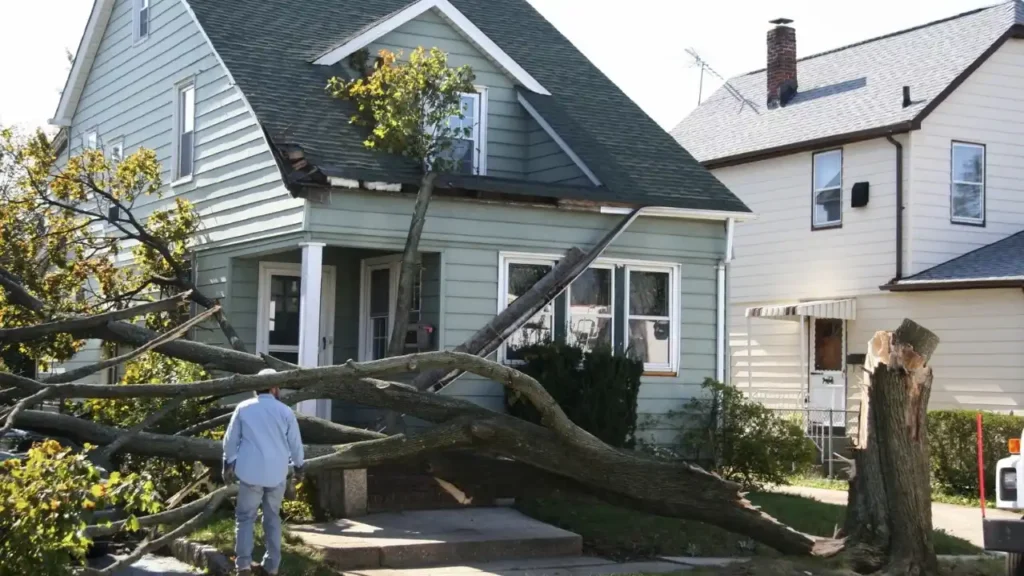
If you’re reading this with a tree on your roof, across your drive, or leaning ominously over your conservatory first, take a moment. Most situations look worse than they actually are, and the next 24 hours matter far more than the next 24 minutes.
Bournemouth, Poole and Christchurch sit on the South Coast and bear the brunt of Atlantic storms every winter. During Storm Eunice in 2022, BCP Council teams cleared 140 fallen trees in a single day, with gusts of 99mph recorded at the Southbourne weather station. Storm Ciarán brought roughly 60 fallen tree reports across the BCP area, and Storm Chandra in early 2026 caused yet more disruption. If a tree’s come down on your property, you’re not alone — and there’s a clear, calm process to follow.
Step 1: Make Sure Everyone Is Safe (First 10 Minutes)
Before you do anything else, check on people, pets and immediate hazards.
Stay well clear if the tree is touching a power line. Live cables can energise the tree, the ground around it, and any metal fencing nearby. Ring 105 for the national power emergency line, which connects you to UK Power Networks or your local distribution operator. If anyone is injured or there’s a fire risk, dial 999 straight away.
Also watch for:
- Gas leaks (smell of rotten eggs, hissing sounds)
- Hanging branches (known as widow-makers in the trade) that could still drop
- Cracked or leaning trees that haven’t fully fallen yet
- Damaged roofing tiles that could slide off
Keep children and pets indoors until a professional has assessed the site.
Step 2: Document the Damage Before You Touch Anything
This step protects your insurance claim. Insurers reject claims every year because homeowners cleared up before photographing the damage.
Take wide shots of the whole scene, then close-ups of:
- Where the tree fell from (the stump or root plate)
- Any damage to the roof, walls, fences, outbuildings or vehicles
- The tree’s trunk and branches at rest
- Time-stamped weather conditions if possible
Keep all photos and videos backed up. Note the exact date, time, and wind conditions — you can cross-reference this with Met Office data later if your insurer disputes whether it qualified as a storm.
Step 3: Ring Your Buildings Insurance Provider
Most standard buildings insurance policies in the UK cover storm damage caused by falling trees. This usually includes:
- Damage to the roof, walls, windows and doors
- Damage to outbuildings (garages, sheds)
- The cost of removing the fallen tree from your property
- Alternative accommodation if your home is uninhabitable
The Association of British Insurers (ABI) generally classifies a storm as winds of 55mph or more, heavy rain, snow or hail. If wind speeds didn’t quite hit that threshold, claims can be denied — so always check your policy wording.
A few things to know:
- Fences, gates and garden walls are often excluded unless damaged by a falling tree.
- Your insurance has a mitigate damages clause — meaning you must take reasonable steps to prevent further damage. Tarps over a hole in the roof, for example.
- If a neighbour’s tree falls on your property, you usually claim on your own policy — not theirs.
- If a council tree damages your home, you still claim on your own buildings insurance, then notify the council separately.
Step 4: Report Fallen Trees to BCP Council
If a tree has come down on a public road, pavement, park or council-owned land in Bournemouth, Christchurch or Poole, report it to BCP Council via their Report It function on bcpcouncil.gov.uk.
The council’s Highways and Parks teams handle public-land clearance — you don’t need to (and shouldn’t) deal with it yourself. During major storms, they prioritise blocked roads and dangerous trees first, so smaller jobs may take longer.
If the tree is entirely on your own land, the council won’t remove it — that’s your responsibility, and where a qualified tree surgeon comes in.
Step 5: Call a Qualified Emergency Tree Surgeon
Storm-damaged trees are genuinely dangerous to remove. They sit under unusual tension, and a single wrong cut can cause branches or whole trunks to spring violently. This isn’t a job for a chainsaw and a brave attitude.
When you ring an emergency tree surgeon in Bournemouth, ask for:
- NPTC or LANTRA qualifications (proof of competence)
- Public liability insurance of at least £5 million
- Compliance with BS 3998 (the UK Tree Work Standard)
- A clear, written quote — even in an emergency
A reputable local firm should respond within an hour and arrive the same day. At Tree Solutions, we cover emergency call-outs across Bournemouth, Poole, Christchurch, Ferndown, Wimborne and Ringwood — including evenings and weekends after major storms.
What If the Tree Has a Tree Preservation Order (TPO)?
This catches a lot of homeowners out. Even after a storm, you cannot legally cut down or significantly prune a tree protected by a Tree Preservation Order without council permission. There are hundreds of TPOs across the BCP area, and 48 designated conservation areas.
The good news: there’s an emergency exemption. If the tree poses an immediate danger, a qualified tree surgeon can carry out essential safety work — but you must notify BCP Council with photographic evidence and an arborist’s report within five days. Unauthorised work on a protected tree can result in fines up to £20,000 in a magistrates’ court.
A professional tree surgeon will handle this paperwork for you.
How Much Does Emergency Tree Removal Cost in Bournemouth?
Costs vary based on tree size, access, and complexity, but as a guide:
| Job Type | Typical Cost |
|---|---|
| Small storm-damaged tree (under 6m) | £200 – £450 |
| Medium tree, garden access | £450 – £900 |
| Large tree on house or near power lines | £900 – £2,000+ |
| Stump grinding (separate) | £160 – £320 |
If your insurance is covering the work, get a fully itemised quote — this is what the insurer wants to see.
How to Reduce the Risk Before the Next Storm
Once the immediate situation is sorted, prevention is far cheaper than cure. We recommend:
- Annual tree inspections for any tree over 6 metres or close to your home
- Crown thinning to let wind pass through, rather than push against, the canopy
- Deadwooding to remove brittle, broken branches before they fall
- Root checks for trees on clay soil or near drains
FAQs:
Who do I call when a tree falls on my house in the UK?
Call your buildings insurance provider first, then a qualified emergency tree surgeon. If anyone is hurt or a power line is involved, ring 999 immediately.
Does home insurance cover fallen tree removal?
Yes — most standard UK buildings insurance policies cover removal of a tree that has fallen on your property due to a storm, plus any damage caused. Removal of a healthy tree you simply want gone is not covered.
Who is responsible if my neighbour’s tree falls on my house?
You are. In the UK, you claim on your own buildings insurance regardless of whose tree it was, unless you can prove the neighbour was negligent (for example, the tree was visibly diseased and they were warned).
How quickly can a tree surgeon come out after a storm?
Reputable Bournemouth tree surgeons aim to attend genuine emergencies within a few hours, though after major storms like Eunice or Ciarán, demand can stretch this. Call early.
Can I remove a storm-damaged tree myself?
We strongly advise against it. Storm-damaged trees are under unpredictable tension and cause many of the most serious chainsaw accidents recorded each year in the UK.
How do I report a fallen tree in Bournemouth?
For trees on public land, use the BCP Council Report It function at bcpcouncil.gov.uk. For trees on private land, contact a qualified tree surgeon directly.