
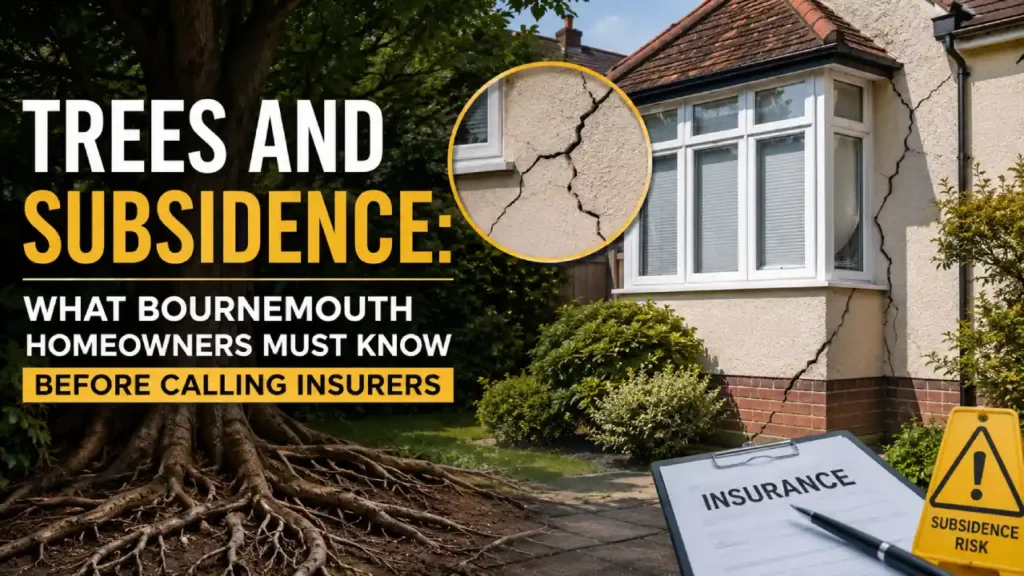
Yes, tree roots can cause subsidence, but it happens far less often than many homeowners fear, and it is much less likely on Bournemouth’s mostly sandy soil than in the clay-heavy parts of England. Before you panic, call your insurer, or reach for a chainsaw, it pays to understand what is really going on beneath your home. Acting too quickly can cause more damage than the trees ever would.
This guide explains what subsidence is, whether your trees are a genuine risk here in Bournemouth, how to spot the warning signs, and the calm, correct steps to take before you make that call to your insurer.
What Is Subsidence, and Can Trees Really Cause It?
Subsidence is the downward movement of the ground beneath your home’s foundations, which can pull the structure with it and cause cracks. Trees can contribute to it, but only in particular soil conditions, and usually only during long dry spells.
Subsidence vs Settlement vs Heave
These three words get muddled constantly, and knowing the difference saves a lot of worry. Settlement is the gentle, expected movement of a new building as it beds into the ground shortly after construction, and it is normally harmless. Subsidence is the ground sinking later in a building’s life, often unevenly, which is the one that causes concern. Heave is the opposite: the ground swelling and pushing upwards, which most often happens after a large tree is removed and the soil it once dried out becomes wet and expands again. That last point matters enormously, and we will come back to it.
How Tree Roots Actually Trigger Subsidence
Trees do not crack houses by pushing against them. They do it by drinking. During the growing season, a thirsty tree draws large volumes of water out of the soil through its roots. In certain soils, mainly clay, that loss of moisture makes the ground shrink, and if the shrinking happens under your foundations, the building can drop. This is why the problem is tied so closely to clay and to dry weather. In a typical year, around 60 per cent of valid subsidence claims come from root-induced clay shrinkage, and that figure can climb to as much as 85 per cent during prolonged dry spells. The roots themselves can also reach surprisingly far, sometimes up to twice the height of the tree.
Is Subsidence a Big Risk in Bournemouth? The Local Soil Picture
For most of Bournemouth, the subsidence risk from trees is relatively low, because the town sits largely on sand and gravel rather than the shrinkable clay that causes most problems. This is genuinely good news, and it is the part most national guides get wrong for our area.
The honest, complete picture is this. South-east Dorset around Bournemouth and Poole lies on Tertiary beds of Eocene clays, sands and gravels, producing the thin soils that historically supported the area’s heathland. Sand and gravel drain freely and do not shrink and swell the way clay does, so they rarely cause tree-related subsidence. However, the word “clays” in that description matters, because there are pockets of London Clay and similar beds across the wider area. So while the typical Bournemouth garden is lower risk than a home on the clay belt of the South East, it is not no risk, particularly after a hot, dry summer or if your specific plot happens to sit on a clay seam. The sensible approach is informed calm rather than either panic or complacency.
Which Trees Are Most Likely to Cause Subsidence?
The trees most associated with subsidence are large, fast-growing species with a high demand for water, planted close to a building on clay soil. The species matters, but so does the distance and the soil.
High Water-Demand Species to Watch
A handful of trees come up again and again in subsidence cases because they drink heavily. Oak, willow and poplar are the classic culprits, with elm and eucalyptus also on the list. Willows in particular are notorious water-seekers and are a poor choice near any building. None of these trees is dangerous simply by existing, but a mature one of these species growing close to your foundations on clay deserves attention. A small, slow-growing ornamental tree at a sensible distance is rarely a concern.
How Far Should a Tree Be From Your House?
As a general rule of thumb, a tree should be no closer to your house than its expected full mature height, and high water-demand species such as oak, willow and poplar should be further still. A small tree might sit happily a few metres away, while a large oak ideally wants a distance similar to its eventual height. These are guidelines rather than strict laws, because soil type and foundation depth change the picture, but they are a useful sense check when planting something new or assessing an existing tree.
How to Spot the Signs of Subsidence
The clearest sign of subsidence is sudden, diagonal cracking in your walls that is wider at the top than the bottom, often appearing near doors and windows. Not every crack means trouble, so it helps to know what the worrying ones look like.
What Subsidence Cracks Look Like
Most homes have a few harmless hairline cracks. The cracks that warrant a closer look are diagonal and tapered, typically wider than around three millimetres, and they often run from the corners of windows and doors. Other telltale signs include doors and windows that suddenly stick, wallpaper rucking or creasing at the joints, and gaps appearing where skirting boards meet the floor. If you notice several of these together, it is worth getting a professional opinion rather than guessing.
Why Late Summer Is When Problems Show
Subsidence linked to trees usually reveals itself in late summer and early autumn, because that is when the soil is at its driest and tree roots have been drawing water all season. If cracks appear or widen noticeably during a hot, dry spell and then seem to settle in winter, that seasonal pattern is itself a clue that moisture and vegetation may be involved. After the long dry summers we are increasingly seeing, this is the time of year to stay observant.
What to Do Before You Call Your Insurer
Before contacting your insurer, document the cracks with dated photographs, resist any urge to remove the tree, and understand that the process will involve investigation rather than an instant answer. A calm, well-prepared start protects both your home and your claim.
Why You Should Not Rush to Remove the Tree
This is the single most important point in this guide. Felling a mature tree that has been drying out clay soil can cause the ground to swell back up, leading to heave, which can do as much structural damage as the original subsidence or more. Removing the wrong tree, or removing it the wrong way, can turn a manageable situation into an expensive one. There is also a strong case for keeping trees and simply managing them, since careful, regular pruning can reduce a tree’s water demand and keep root growth in check without the risks that felling brings. Always get professional advice before any tree is touched.
How the Insurance Claim Process Works
Most buildings insurance policies in the UK cover subsidence, though excesses for subsidence claims are typically higher than for other damage. Once you report a concern, your insurer will usually appoint a loss adjuster, and specialists such as a structural engineer or ground engineer to investigate the true cause. They commonly monitor the cracks and ground over a period of months, sometimes across a full set of seasons, to confirm what is happening before any repairs are agreed. It is a slower process than many people expect, but that patience exists to make sure the real cause is fixed rather than guessed at.
Who Is Liable? Neighbour, Council and TPO Trees
If a tree causing subsidence belongs to a neighbour or the council, liability becomes more complicated, and these cases are often handled through an industry agreement rather than the courts. This is one of the most stressful parts of any subsidence situation, so it helps to know how it works.
Many domestic cases involving a neighbour’s or a local authority’s tree are dealt with under an Association of British Insurers arrangement known as the Domestic Subsidence Tree Root Claims Agreement, which sets out how insurers handle these claims between themselves rather than homeowners pursuing each other directly. Claims involving a tree owned by a neighbour, the council or a housing association can take longer, because more evidence is needed to establish exactly which tree and whose responsibility is involved. The fair and practical first step is usually a polite conversation with your neighbour, kept friendly, while your insurer handles the formal side.
When the Tree Has a Tree Preservation Order
If the tree involved is protected by a Tree Preservation Order or sits in a conservation area, you cannot simply have it removed or even heavily pruned without permission from BCP Council, even when subsidence is suspected. This can slow things down, but it does not block a resolution. Your arborist and insurer will factor the protection into the plan, and the council will consider the structural evidence as part of any application. You can check whether a tree is protected before doing anything, and our guide on [getting permission to remove a problem tree in Bournemouth] walks through how that works.
Managing Trees to Reduce Subsidence Risk Without Felling
In most cases, you can reduce a tree’s subsidence risk without cutting it down, through professional pruning, crown reduction and, occasionally, root barriers. Keeping a healthy tree is usually better for your garden, your street and even your foundations than removing it.
Crown reduction, which carefully reduces the size of the tree’s canopy, lowers how much water the tree needs and therefore how much moisture it pulls from the soil. A sensible, repeating pruning cycle keeps that demand in check year after year. In some situations a root barrier can be installed between the tree and the building, though these are not suitable everywhere and need expert judgement. The right answer depends on the species, the soil, the distance and the foundations, which is exactly why an assessment by a qualified tree specialist is worth far more than guesswork.
Does Subsidence Affect Your Home’s Value?
A history of subsidence can affect a home’s value and make some buyers cautious, but a properly investigated and repaired case, with the paperwork to prove it, reassures buyers far more than an unexplained crack. Honesty and documentation are everything here. If subsidence has been correctly diagnosed, the cause addressed, and the repair certified, many buyers and their surveyors will treat it as a resolved issue rather than a live threat. Keeping every report, certificate and piece of correspondence is genuinely valuable, both for your own peace of mind and for any future sale.
Frequently Asked Questions
Can tree roots cause subsidence to my house?
Yes, but mainly on shrinkable clay soil and usually during dry spells, when thirsty roots draw moisture from the ground and the clay shrinks. On Bournemouth’s largely sandy soil, the risk is lower than in clay areas.
Which trees are most likely to cause subsidence?
Large, high water-demand species such as oak, willow, poplar, elm and eucalyptus are most often associated with subsidence, especially when planted close to a building on clay.
How far should a large tree be from my house?
As a guideline, keep a tree at least as far from your house as its expected mature height, and further still for thirsty species like willow, oak and poplar.
Should I remove a tree if I suspect subsidence?
Not without professional advice. Removing a tree that has dried out clay soil can cause heave, which is upward ground movement that can damage your home as badly as subsidence. Always get an expert assessment first.
Who is responsible if my neighbour’s tree causes subsidence?
These cases are often handled between insurers under an Association of British Insurers agreement rather than directly between neighbours. Report it to your insurer and keep any conversation with your neighbour friendly.
Does Bournemouth have a high subsidence risk?
Generally no. Most of Bournemouth sits on free-draining sand and gravel, which rarely causes tree-related subsidence, though pockets of clay exist and risk rises after long, dry summers.
When to Call a Local Tree Specialist
If you have a large tree close to your home, cracks you are unsure about, or a tree you are worried about removing, the safest first step is a professional assessment rather than a hasty decision. A qualified local arborist can judge the species, the distance, the soil and the right course of action, and can prune or reduce a tree correctly to lower the risk while keeping it healthy.
Getting that advice early almost always costs less than reacting in a panic later, and it protects both your home and the trees that make our gardens and streets worth living in. If you would like an honest, local opinion, our [tree surgery service] can help with crown reduction and safe pruning, you can read more in our related guide on [tree roots and property damage], and you are always welcome to get in touch for friendly advice and a no-obligation quote.