
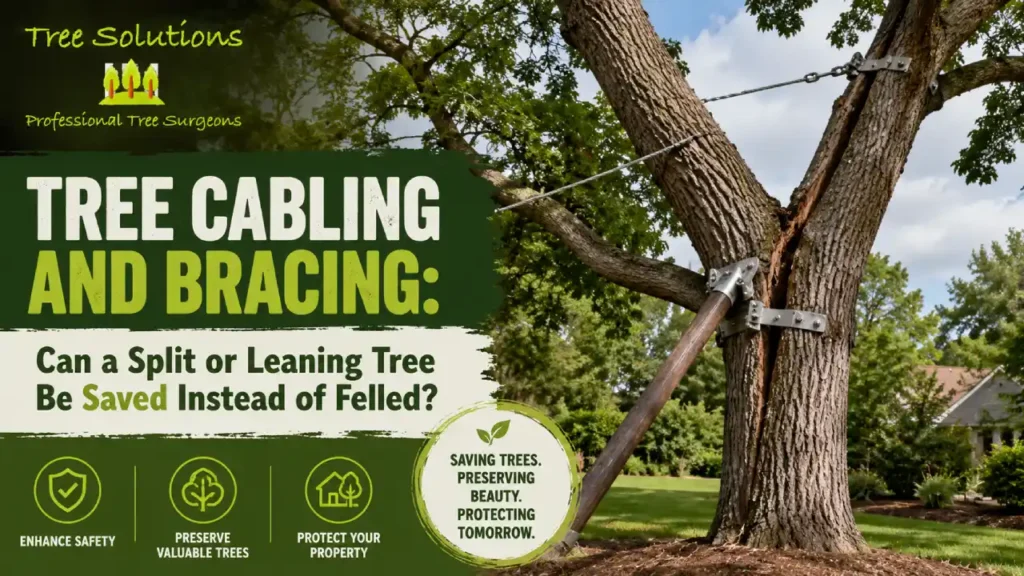
Quick answer: Yes, many split or leaning trees can be saved instead of felled. Tree cabling and bracing add hidden support to weak stems and branches, holding them steady in high winds. If the trunk is sound and the roots are stable, a qualified arborist can often keep the tree safe for years rather than removing it.
A cracked trunk or a tree leaning further than it used to is unsettling, and the first thought is usually that the whole tree has to come down. That is not always true. In a lot of cases, the right support system buys a healthy tree many more safe years. This guide explains how tree cabling and bracing work, which trees are worth saving, when felling is the safer choice, and what the work typically costs in the UK.
What is tree cabling and bracing?
Tree cabling and bracing is a way of giving a weak or damaged tree extra structural support so it does not fail in strong wind or under its own weight. It is one of the gentler options in professional tree surgery, and it is often used in place of removal. The aim is simple. Keep the tree standing safely, protect whatever is underneath it, and let the tree carry on growing.
There are two parts to the job, and they are often used together.
What tree cabling does
Cabling supports the upper part of the tree, the crown. A flexible cable is fitted high up between two stems or large branches so they share the load and stop pulling apart in the wind. It is most often used where a tree has two main stems of similar size growing from the same point. These are called co-dominant stems, and the join between them can be weak, especially when bark gets trapped inside the union.
What tree bracing does
Bracing supports the lower, heavier part of the tree where direct strength is needed. Threaded rods, usually galvanised steel, are fitted through a split trunk or a weak fork to hold the two sides together. Bracing is the usual answer for a trunk that has started to split at the point where it divides.
Dynamic and static support systems
There are two styles of support, and a good arborist picks the right one for the tree.
- Dynamic systems allow the tree to sway and move naturally while still catching it if a stem starts to fail. Modern synthetic kits such as the Cobra bracing system work this way, with a shock absorber built in. The movement actually helps the tree lay down its own reinforcing wood over time.
- Static systems hold parts of the tree firmly in place with little movement. Steel cable and brace rods fall into this group, and they are used where a split or fork needs to be held tightly.
Can a split tree be saved?
Often, yes. A split tree can usually be saved if the split is fresh, the wood around it is still healthy, and the two halves can be drawn back together and braced before decay sets in. The sooner it is looked at, the better the result.
A trunk that has split down a fork after a storm is a classic case for bracing. If you have just come through bad weather, our guide on what to do with a storm damaged tree walks through the first safe steps. A long, dried out split full of rot is a different story, and that tree may be past saving.
Can a leaning tree be saved or straightened?
A leaning tree can often be saved, but a long established tree usually cannot be pulled fully upright. A lean that has been there for years is normal for many trees and is not a problem on its own. What matters is whether the lean is changing.
A tree is far more worrying when the lean is new or getting worse, when the soil is lifting or cracking on one side, or when roots are starting to show. That points to movement at the root plate, which is the pad of roots and soil that anchors the tree. Cabling can help a leaning tree share wind load with sturdier neighbours, but if the roots themselves are failing, support alone will not make it safe.
Signs your tree is a good candidate for cabling and bracing
Some trees are well worth saving with support. Yours may be a good candidate if you notice any of the following.
- Two or more main stems growing from one point, known as co-dominant stems.
- A narrow, V shaped fork with bark squeezed inside it, called included bark.
- A fresh crack or split at a fork or along a limb.
- Long, heavy branches that sag or droop, especially over a path, drive or building.
- A tree of real value to you, such as a mature, heritage or veteran tree, that is structurally weak but still healthy.
If you are unsure what you are looking at, our overview of common tree problems helps you tell normal quirks from genuine warning signs.
When a tree is too far gone to save
Support systems are not a fix for every tree. Felling is usually the safer choice when:
- the main trunk is extensively decayed or hollow and no longer sound,
- the roots are failing and the whole tree is moving in the ground,
- a large part of the crown has already collapsed,
- the tree is dead, or
- the tree poses an immediate danger to people or property that support cannot remove.
If a tree is clearly unsafe right now, treat it as urgent. The warning signs in our guide on emergency tree surgery will help you decide whether to call straight away. Honest advice matters here, and a reputable surgeon will tell you when removal is genuinely the right call rather than selling you a support system that will not work.
How tree cabling and bracing works, step by step
The work should always be carried out by a qualified arborist and to the British Standard for tree work, BS 3998. A typical job runs like this.
- Survey. The arborist inspects the tree, checks the trunk, the fork and the roots, and decides whether support is realistic and safe.
- Plan. They choose the right mix of cabling and bracing and the correct strength of materials for the size of the tree.
- Reduce the load. Often the crown is lightened first with careful pruning, sometimes called a crown reduction, so there is less weight and wind for the supports to hold.
- Fit the supports. Cables are installed high in the crown and braces are fitted through the trunk or fork as needed.
- Tidy and check. The site is cleared and the work is recorded so it can be checked again later.
This is skilled work at height, so it sits firmly within professional tree surgery rather than something to attempt yourself.
How long does tree cabling and bracing last?
A well installed support system can last well over a decade. Quality synthetic cabling systems are designed to stay in place for around 12 years before they need replacing, while steel rods can last much longer. The important point is that supports are not fit and forget. They should be inspected at least once a year, and after any major storm, so any wear can be caught early. Annual checks are a normal part of looking after a supported tree.
How much does tree bracing cost in the UK?
As a rough guide, a single straightforward cable or brace often costs in the region of a few hundred pounds, while larger trees needing several supports cost more. The final figure depends on the size of the tree, how many supports it needs, access to the site, and whether crown reduction is needed first.
Even at the higher end, support is usually far cheaper than full felling, stump removal and replanting. If you are weighing up the two, our breakdown of what affects the cost of tree removal makes the comparison clearer. The only way to get an accurate price is a site visit, so it is always worth asking for a free quote.
Do you need permission to brace a tree?
You may need permission. If your tree has a Tree Preservation Order on it, or your property sits in a conservation area, you usually need consent from the council before any significant work, including some support work and the pruning that goes with it. It is always best to check first. Our guide on whether you need permission to work on a problem tree explains how to find out, and a good tree surgeon will help you sort this before any work starts.
Saving trees on the Dorset coast
Trees in Bournemouth, Poole and Christchurch take a real battering from coastal winds off the South Coast, which is exactly why so many local trees develop weak forks and leaning trunks. That same exposure is why cabling and bracing is such a useful option here. A mature tree that gives a garden its character and shade is worth saving where it safely can be, and the right support system often does just that. At Tree Solutions we cover Bournemouth, Poole, Christchurch and the surrounding towns including Ferndown, Wimborne and Ringwood, and we are happy to advise on whether your tree can be supported or needs removing.
Frequently asked questions
Can a tree that has split down the middle be repaired?
A freshly split tree can often be braced back together if the wood is still healthy and the work is done quickly. An old, decayed split is usually beyond repair.
Does cabling and bracing hurt the tree?
Done correctly, no. Modern synthetic systems cause very little damage, and even steel rods cause only minor, localised wounds that a healthy tree seals over.
Is it safe to leave a leaning tree?
A long standing lean is often fine. A new or worsening lean, lifting soil or exposed roots are warning signs that the tree may be unsafe and should be checked promptly.
Is cabling cheaper than removing the tree?
In most cases, yes. Supporting a tree is usually far less expensive than felling it, grinding the stump and planting a replacement.
Can I install a tree brace myself?
No. It involves working at height and getting the strength and placement exactly right, so it should always be left to a qualified, insured arborist.
Not sure whether to save your tree or fell it?
The honest answer often depends on details you can only judge in person, such as how sound the trunk is and whether the roots are moving. If you have a split, leaning or weak tree in Bournemouth, Poole or Christchurch, get in touch for a free, no obligation quote and we will tell you straight whether it can be saved or needs to come down.