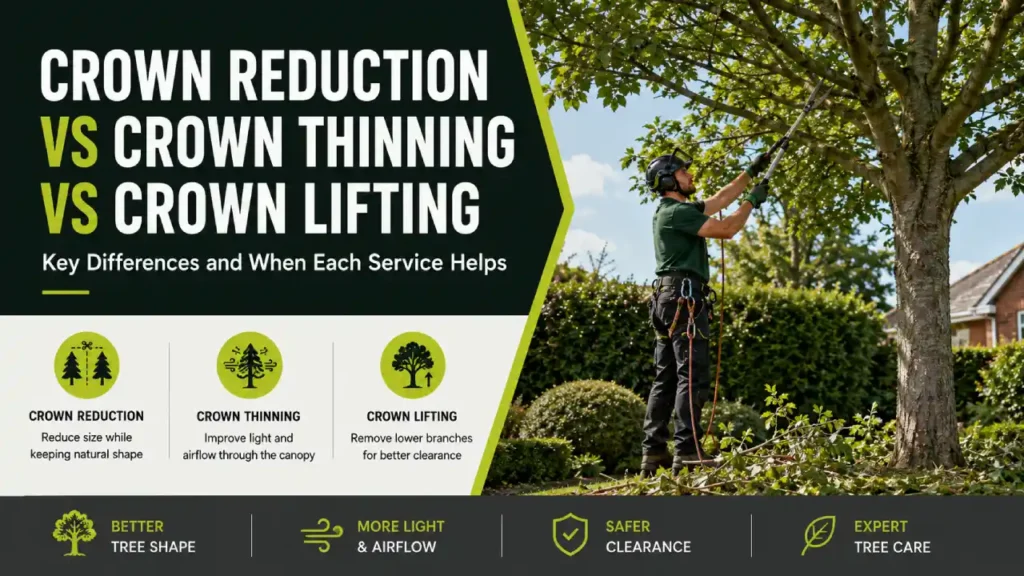
Crown reduction makes a tree’s canopy smaller. Crown thinning reduces its density without significantly changing its overall size or shape. Crown lifting raises the bottom of the canopy by removing or shortening lower branches. The right service depends on whether your problem is overall tree size, a dense canopy or insufficient clearance beneath the tree.
The terms sound similar, which is why homeowners can easily request the wrong type of pruning. Asking for a crown thin when the real problem is a tree that has become too tall, for example, will not achieve the result you expect.
Understanding crown reduction vs crown thinning, and where crown lifting fits into the picture, makes it easier to discuss the tree clearly with your tree surgeon.
Crown Reduction vs Crown Thinning vs Crown Lifting at a Glance
| Tree work | What changes? | Does tree height reduce? | Does crown spread reduce? | Typical purpose |
|---|---|---|---|---|
| Crown reduction | Overall canopy dimensions | Yes, if specified | Yes, if specified | Manage a tree that is too large for its surroundings |
| Crown thinning | Density within the canopy | No | No | Allow more light and air through while retaining overall size |
| Crown lifting | Height of the lowest canopy | No | Usually no | Create clearance beneath the tree |
The Arboricultural Association treats these as three distinct pruning operations. A crown thin should not be expected to reduce the height of a tree, while a crown lift changes the clearance beneath the canopy rather than reducing its top.
Start With the Problem You Want to Solve
The easiest way to choose the correct tree work is not to start with the arboricultural terminology.
Start with the problem.
My Tree Has Become Too Large
Most likely option: crown reduction
If the canopy has become too tall, too wide or unsuitable for the available space, crown reduction is usually the technique worth discussing.
My Tree Is the Right Size but the Canopy Is Very Dense
Most likely option: crown thinning
Thinning can allow more light and air to pass through the crown while retaining its overall dimensions.
Branches Are Hanging Too Low
Most likely option: crown lifting
Where lower branches interfere with a driveway, path, lawn, building or access route, crown lifting addresses the lower part of the canopy.
That simple distinction prevents many misunderstandings.
What Is Crown Reduction?
Crown reduction involves decreasing the height, spread or both dimensions of a tree’s crown.
Rather than indiscriminately chopping the ends from branches, a proper reduction makes selective cuts back to appropriate lateral growth points. The aim is to retain the tree’s main crown framework and produce a similar but smaller outline.
The Arboricultural Association advises that reduction cuts should be kept as small as possible and that reductions should, where possible, be described using actual measurements.
A professional specification might therefore say:
Reduce crown height by approximately 2m and lateral spread by approximately 1m.
That is far clearer than:
Cut the tree back a lot.
When Might Crown Reduction Be Appropriate?
It may be considered when:
- A tree has become too large for its setting
- Branches are extending towards a building
- The canopy extends significantly across a boundary
- Particular limbs are carrying excessive mechanical load
- The tree requires carefully controlled size management
- Shading needs to be reduced without removing the tree
- An arborist recommends reducing stress on individual branches
The Arboricultural Association identifies reducing mechanical stress, improving suitability for the immediate environment and reducing shading among the potential purposes of crown reduction.
What Crown Reduction Does Not Mean
Crown reduction is not the same as topping.
Topping generally refers to crude removal of substantial portions of the crown without retaining an appropriate natural framework. The Arboricultural Association describes topping as an outdated, heavy-handed form of pruning and specifically warns that crown reduction should not be confused with it.
A well-reduced tree should still look like the same tree, just with carefully reduced dimensions.
What Is Crown Thinning?
Crown thinning selectively removes a proportion of smaller branches to create a more even and less dense canopy.
Unlike reduction, the overall height and spread should remain largely unchanged.
This point matters.
If your tree is 15 metres tall before a crown thin, you should not expect thinning itself to turn it into a 12-metre tree.
The Arboricultural Association defines crown thinning as systematic removal of smaller branches to create an even foliage density while maintaining the tree’s overall size and shape. It advises that thinning should not exceed the stated percentage and should not exceed 30% overall.
Why Is Crown Thinning Carried Out?
Possible objectives include:
- Allowing additional light through the canopy
- Increasing air movement
- Reducing canopy density
- Reducing some wind resistance
- Removing weight selectively
- Maintaining the tree’s existing overall size
Crown thinning is generally associated with broad-leaved trees.
Crown Thinning Is Not a Size-Reduction Technique
This is probably the biggest homeowner misconception.
If the complaint is:
The tree is simply too big.
Thinning alone is unlikely to solve it.
The crown outline remains in approximately the same place. There are simply fewer selected branches within that outline.
This is why choosing between crown reduction vs crown thinning starts with identifying whether size or density is the real concern.
What Is Crown Lifting?
Crown lifting, sometimes called crown raising, manages the lowest part of a tree’s canopy.
It involves removing lower branches or preparing them for future removal so that the clear space between the ground and canopy increases.
This can be useful where branches interfere with:
- Pedestrian paths
- Driveways
- Vehicle access
- Lawns
- Garden seating
- Buildings
- Visibility
- Other uses of the space beneath the tree
The operation should usually be specified according to the clearance required.
For example:
Crown lift to provide approximately 3m clearance above ground level.
The Arboricultural Association recommends specifying crown lifting relative to a fixed point or required clearance.
Crown Lifting Requires More Care on Mature Trees
Removing large low branches directly from the trunk can create substantial wounds.
For older or mature trees, the Arboricultural Association advises avoiding or restricting this type of removal where possible. Shortening primary branches or working with secondary branches may sometimes be preferable.
Its guidance also says crown lifting should normally be restricted to less than 15% of the live crown height and should leave the crown occupying at least two-thirds of the total tree height.
That is why simply removing every branch below an arbitrary height is not responsible crown lifting.
Which Service Gives You More Light?
This depends on where the shade is coming from.
Dense foliage throughout the canopy
Crown thinning may allow additional light to filter through without significantly altering the tree’s dimensions.
Low branches blocking windows or garden space
Crown lifting may improve light closer to ground level by opening the space below the canopy.
An oversized canopy heavily shading the property
A carefully specified crown reduction may sometimes be more appropriate.
There is no universal “best pruning method for more light”. The position of the tree, direction of the property, species, canopy structure and actual source of shade all matter.
Which Service Helps if the Tree Is Too Close to a House?
Again, identify the actual issue.
If individual low branches approach gutters, roofs or walls, selective pruning or lifting may be sufficient.
If the whole side of the canopy is extending towards the property, a lateral crown reduction may be considered.
If the tree is structurally concerning, crown work should not be prescribed purely from the distance to the house. The tree may need a broader condition assessment first.
Avoid assuming that every tree close to a building needs to be dramatically reduced.
What if the Tree Catches a Lot of Wind?
This requires care.
Crown thinning can reduce some wind resistance, while crown reduction may be used to reduce mechanical stress on parts of a tree. However, neither should be treated as a guaranteed way of making a structurally defective tree safe. The Arboricultural Association notes that thinning can reduce weight but does not necessarily reduce leverage on the tree’s structure.
If you notice:
- Cracks in major unions
- A recent lean
- Movement around the roots
- Split stems
- Significant decay
- Large dead branches
the priority should be an assessment rather than simply ordering a thin or reduction.
Crown Reduction vs Crown Thinning for a Dense, Large Tree
Sometimes a tree has two problems.
It may be both:
- Too large for its space
- Very dense internally
That does not automatically mean a heavy reduction followed by heavy thinning.
Every pruning cut creates a wound and removes live leaf-bearing material. The total amount of work therefore needs to be considered together.
A qualified tree surgeon may recommend a lighter combination, staged management or only the operation that addresses the most important problem.
Can Crown Lifting and Crown Reduction Be Combined?
Yes, different pruning operations can form part of the same specification where there is a valid reason.
For example, a Bournemouth homeowner might have a mature tree with:
- Low branches interfering with a driveway
- Lateral growth approaching the house
The specification might include a modest lift over the driveway plus selective lateral reduction towards the property.
The important point is that each operation should have a defined objective.
“Trim the whole tree” is not a useful professional specification.
When None of These Three Services Is the Right Answer
Crown work is not the solution to every tree problem.
Dead or Dangerous Branches
Deadwood removal may be more appropriate if the primary concern is individual dead branches rather than crown size or density.
A Split or Weak Fork
Structural assessment, reduction or in some situations cabling and bracing may be considered instead of simply thinning the crown.
A Severely Declining Tree
Pruning may not solve advanced root decay, serious structural failure or widespread decline.
A Previously Pollarded Tree
A tree already managed through an established pollarding cycle requires a different approach from an ordinary crown reduction.
A Tree That Is Simply in the Wrong Location
Repeated heavy pruning may not be a sustainable long-term answer where the species and available space are fundamentally incompatible.
The tree should be assessed as a whole before selecting a pruning label.
What Should a Tree-Surgery Quote Actually Say?
A good specification should be clearer than:
- Cut back tree
- Reduce substantially
- Thin it out
- Trim branches
- Take some off the top
The Arboricultural Association recommends measurable descriptions where possible.
Crown Reduction
A specification may describe:
- Amount removed in metres
- Finished approximate height
- Finished approximate spread
- Whether the reduction applies all around or to one side
Crown Thinning
It should state:
- Percentage of crown to be thinned
- Any specific areas of focus
- Any additional deadwood or crossing branches being addressed
Crown Lifting
It should state:
- Required final clearance
- Where the lift applies
- Whether branches are removed or shortened
Clear specifications make quotations easier to compare and reduce the chance of customer and contractor expecting different results.
Do You Need Permission for Crown Work in Bournemouth?
Possibly.
BCP Council states that permission is required before work is carried out on a tree protected by a Tree Preservation Order. Unauthorised pruning or felling of a protected tree can lead to prosecution.
Trees within conservation areas can also be protected.
BCP Council states that where a tree does not already have a TPO, conservation-area protection generally applies where the stem exceeds 7.5cm in diameter measured 1.5m above ground. Written notification of the intended work is required.
Before arranging crown reduction, thinning or lifting in Bournemouth, check:
- Whether the tree has a TPO
- Whether the property lies within a conservation area
- Whether another planning condition affects the tree
- Whether wildlife constraints need consideration
Do this before work begins, not after the tree has been pruned.
Choosing the Right Crown Work for a Bournemouth Garden
A useful starting point is:
| Your main problem | Likely technique to discuss |
|---|---|
| Tree is too tall | Crown reduction |
| Tree is too wide | Crown reduction |
| Dense canopy but acceptable size | Crown thinning |
| Need more filtered light through canopy | Crown thinning |
| Branches too low over driveway | Crown lifting |
| Pedestrian clearance required | Crown lifting |
| Growth towards one side of property | Selective/lateral reduction may be considered |
| Dead branches | Deadwood removal rather than routine thinning |
| Split or unstable tree | Assessment before choosing crown work |
| Tree protected by TPO | Permission before work |
This table is a guide, not a diagnosis from a distance.
Species, age, condition, previous pruning and site constraints can change the recommendation.
Common Crown Work Mistakes
Asking for a Thin When You Want a Shorter Tree
Thinning does not significantly reduce overall height.
Asking for a Percentage Reduction Without Knowing What It Means
For crown reduction, actual finished dimensions or metres removed are often clearer than vague percentages.
Removing Too Many Low Branches
Excessive crown lifting can leave a poorly proportioned tree and create unnecessary large wounds.
Treating Topping as Crown Reduction
They are not interchangeable terms.
A good crown reduction retains an appropriate framework and natural outline rather than leaving indiscriminate stubs.
Choosing the Work Before Assessing the Tree
The visible complaint may not be the real problem.
A dense canopy, for example, may distract attention from decay, poor branch unions or root instability that should influence the management plan.
Frequently Asked Questions
What Is the Main Difference Between Crown Reduction and Crown Thinning?
Crown reduction decreases the tree’s overall crown dimensions. Crown thinning removes selected smaller branches to reduce density while keeping approximately the same overall height and spread.
Does Crown Thinning Make a Tree Shorter?
No. Proper crown thinning should not significantly alter the overall size or shape of the tree. If height is the problem, crown reduction is more likely to be the relevant technique.
Does Crown Lifting Reduce Tree Height?
No. Crown lifting raises the bottom of the canopy by managing lower branches. The top of the tree remains essentially unchanged.
Which Crown Work Is Best for More Light?
Crown thinning may improve filtered light through a dense canopy, crown lifting can improve light and clearance below low branches, and reduction may help where overall canopy size is contributing to excessive shade. The appropriate choice depends on the individual tree.
How Much of a Tree Can Be Crown Thinned?
The Arboricultural Association says thinning should not exceed the stated percentage and should not exceed 30% overall. The appropriate amount may be considerably less depending on the tree.
Is Crown Reduction the Same as Topping?
No. Crown reduction uses selective cuts to retain a similar but smaller natural crown framework. Topping is an indiscriminate, heavy-handed form of pruning and should not be confused with professional crown reduction.
Can You Crown Lift a Mature Tree?
Yes, but mature-tree lifting requires particular care. Removing large primary branches directly from the trunk can create significant wounds, so shortening branches or managing secondary growth may be preferable.
Do I Need Permission for Crown Reduction in Bournemouth?
If the tree has a TPO, BCP Council permission is required. Trees in conservation areas may also require written notification before pruning.
Not Sure Which Crown Service Your Tree Needs?
You do not need to diagnose the tree before contacting a tree surgeon.
Start with the result you want:
- Less overall size
- More light
- Better clearance
- Safer branches
- More space around a building
Tree Solutions can assess the tree, its species, condition and surroundings before explaining whether crown reduction, crown thinning, crown lifting or another form of tree management is appropriate.
For trees in Bournemouth, the best result usually comes from choosing the pruning operation that solves the actual problem while removing no more live material than necessary.