
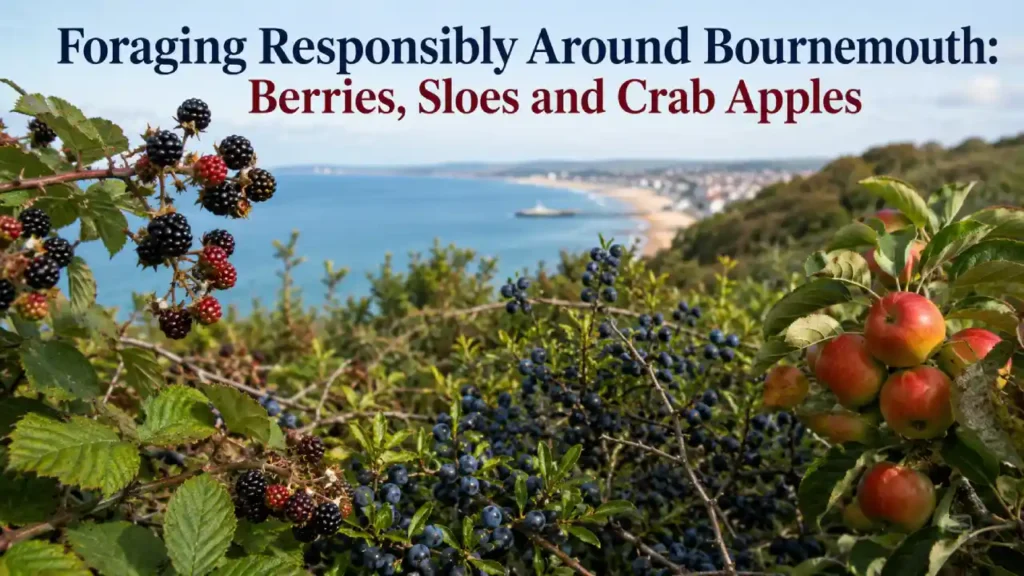
Foraging around Bournemouth is legal, free and genuinely rewarding, as long as you forage for personal use, take only above-ground fruit and foliage, never uproot a plant, and always have permission to be on the land. Autumn is the richest season here, when local hedgerows, woodland edges and coastal paths fill with blackberries, sloes, elderberries, crab apples and rosehips.
This guide answers the questions most people actually ask before heading out: is it legal, where can I go around Bournemouth, what is safe to pick right now, and what do I do with it once I get home. Done thoughtfully, foraging connects you to the seasons on your doorstep. Done carelessly, it harms the very hedgerows that make it possible, so let us do it properly.
Is Foraging Legal in the UK?
Yes, foraging for your own use is legal in most places in England, but it sits within two key laws worth understanding before you start. The Theft Act 1968 effectively allows you to pick wild fruit, flowers, foliage and fungi for personal use without it counting as theft, provided you are lawfully allowed to be where you are standing. The Wildlife and Countryside Act 1981 then sets the limits, chiefly that you must not uproot any wild plant, and must not pick protected species at all.
Put simply, the law lets you enjoy nature’s surplus, not strip it. Picking a handful of blackberries from a public footpath is fine. Digging up the whole bramble, or gathering sacks of fruit to sell, is not.
The Four Fs You Are Allowed to Pick
Foragers use a friendly memory aid called the four Fs: fruit, flowers, foliage and fungi. These are the above-ground parts of wild plants that you may gather in modest amounts for personal consumption. In everyday terms, the berries, leaves, blossoms and mushrooms are fair game for you and your family.
The one firm exception is anything below ground. It is illegal to uproot any wild plant without the landowner’s permission, so the rule is easy to remember: pick the fruit, but never pull up the plant.
Where You Can and Cannot Forage Around Bournemouth
Knowing your plants is only half the job. Knowing the land is the other half, and it catches people out. Most land in the UK is privately owned, so you should never assume that a park, a hedgerow, or a field with a footpath running through it is open for foraging.
A few clear boundaries help. You can generally forage along public footpaths and on common land for personal use. You should never forage on a Site of Special Scientific Interest without consent, as this is specifically illegal under the Wildlife and Countryside Act 1981, and Dorset has many protected heathland and coastal SSSIs. Nature reserves and many parks set their own byelaws, so it is always worth a glance at the signs at the entrance, or a quick check of the relevant council or trust website, before you fill your basket. When in doubt, stick to public rights of way and pick only common, abundant species.
The Golden Rules of Responsible Foraging
Responsible foraging comes down to the spirit of the Countryside Code: respect, protect and enjoy. A few habits keep you on the right side of both the law and nature.
Take only what you will genuinely use. A widely taught guideline is the 30 per cent rule, meaning you leave at least two thirds of what you find. Only ever harvest from plentiful populations, and never pick anything rare or uncertain. Leave plenty behind for wildlife, because those same berries feed birds and small mammals through the lean winter months. And try to leave each spot looking as though you were never there. If you are ever unsure whether something is safe, or whether you are allowed to pick it, the right answer is simply to leave it.
What to Forage Around Bournemouth in Late Summer and Autumn
Bournemouth and the wider Dorset coast offer a brilliant spread of foraging habitats, from inland hedgerows and woodland edges to coastal scrub and heathland fringes. Blackberries and sloes turn up readily in hedgerows along quiet footpaths, and Dorset’s woods and forest edges are reliably generous in autumn. Here is what to look for, and when.
Blackberries
The perfect place for any beginner to start. Late summer through early autumn is peak blackberry season, and brambles line countless local footpaths and hedgerows from late August onwards. They are easy to identify, wonderfully abundant, and make superb crumbles, jams and cordials. As a courtesy, pick at roughly knee height and above rather than at ground level, where passing animals may have been.
Sloes from the Blackthorn
Sloes are the small, dark, plum-like fruits of the blackthorn, Prunus spinosa, and they are the prize ingredient for sloe gin. The blackthorn is a thorny shrub, so watch your hands: its spines are sharp and scratches can become sore, which is one good reason to pick carefully and wear long sleeves.
Sloes ripen through autumn and are traditionally gathered after the first frost, which softens them and mellows their bite. A modern shortcut is to pick them when ripe and simply freeze them overnight, which mimics that frost. They are far too sharp and astringent to enjoy raw, so they are strictly one for the kitchen.
Elderberries
The elder is one of the most useful hedgerow plants of all, generous in both spring and autumn. Its berries are available from late summer into autumn and make excellent syrups and jams, while in spring the creamy elderflowers make a classic cordial.
Two safety points matter here. First, elderberries must be cooked before eating, as the raw berries can cause nausea and stomach upset, and the leaves, bark and roots should never be eaten at all. Always cook your elderberries thoroughly. Second, learn to recognise the elder properly: a woody shrub with bark-covered stems and broad, flat-topped clusters of small dark berries. If a plant has soft green non-woody stems and grows right at the water’s edge, leave it well alone and do not pick it, as confident identification is essential with any berry.
Crab Apples
These miniature wild apples are a true hedgerow treasure, found along hedgerows and woodland edges from late summer. They are far too sharp to enjoy raw, but they come into their own in the kitchen, making beautiful jams, jellies and even homemade cider. Their high natural pectin makes them especially good for helping other fruit preserves to set.
Rosehips and Hawthorn Berries
As the season turns, the hedgerows keep giving. Alongside the sloes and blackberries you will often find rosehips and hawthorn berries. Rosehips are rich in vitamin C and make a lovely syrup, jam or tea, while hawthorn berries can be turned into jellies and sauces. As with elderberries, both are best cooked rather than eaten raw.
Foraging Safely: Mistakes to Avoid
A little caution keeps foraging the happy hobby it should be. The single most important rule never changes: never eat anything you cannot identify with complete confidence. Use a reputable, UK-specific field guide, and if you are at all unsure, leave it.
Be mindful of where you pick, too. Avoid the very edges of farmed fields, which may have been sprayed, along with busy roadsides and any ground that may be polluted. Remember that some hedgerow fruits, including elderberries, rosehips and hawthorn berries, need cooking to be safe and pleasant. And when it comes to wild mushrooms in particular, the genuinely safe route for a beginner is to learn from an experienced forager or a guided walk rather than relying on a phone app, since several poisonous fungi closely resemble edible ones. Dorset has a number of expert-led foraging courses if you would like to build confidence in person.
Simple Things to Make From Your Foraged Fruit
Half the joy of foraging is what happens back in the kitchen. A few classics are hard to beat. Sloe gin is the autumn favourite, made by steeping pricked sloes with gin and a little sugar for two to three months to produce a rich, fruity drink that also makes a lovely homemade gift. Elderberries simmer down into a deep, warming syrup that is wonderful over porridge or stirred into hot drinks through winter. And blackberries combined with crab apples make a beautifully balanced crumble or jelly, the apple lending its natural set to the soft, sweet berries.
Common Questions About Foraging Around Bournemouth
Is foraging legal in the UK?
Yes. Picking the four Fs (fruit, flowers, foliage and fungi) for personal use is legal on land you are allowed to access. Uprooting plants, picking protected species, and foraging to sell are not permitted.
What can you forage in autumn around Bournemouth?
Autumn offers blackberries, sloes, elderberries, crab apples, rosehips and hawthorn berries, found mainly along hedgerows, footpaths and woodland edges across the Bournemouth and Dorset area.
Where can I pick blackberries near Bournemouth?
Blackberries grow abundantly along public footpaths, hedgerows and woodland edges throughout the area from late August. Stick to public rights of way and avoid sprayed field margins and busy roadsides.
Can you pick sloes from a hedgerow?
Yes, sloes can be picked for personal use, ideally in autumn after the first frost or after a night in the freezer. They are too sharp to eat raw but perfect for sloe gin.
Are crab apples safe to eat?
Crab apples are too sour to enjoy raw, but they are completely safe and delicious once cooked into jellies, jams or cider.
Do elderberries need to be cooked?
Yes. Raw elderberries can cause stomach upset and must be cooked before eating. Never eat the leaves, bark or roots of the elder.
A Final Word on Trees and Hedgerows
Hedgerows and wild fruit trees are precious shared resources, and they stay productive only when they are treated with care. Foraging gently, leaving plenty behind, and never damaging the plants keeps them thriving for everyone, including the wildlife that depends on them through winter.
The same principle applies to the trees and hedges in your own garden. A fruit tree or an overgrown hedge crops far better, and stays far healthier, with the right pruning at the right time of year. If you have a tree or hedge that needs attention, our hedge trimming service and tree surgery service can help keep it in good shape, and you are always welcome to get in touch for friendly local advice. Caring for the trees in our gardens is simply the other side of the same coin as enjoying the wild ones around Bournemouth.