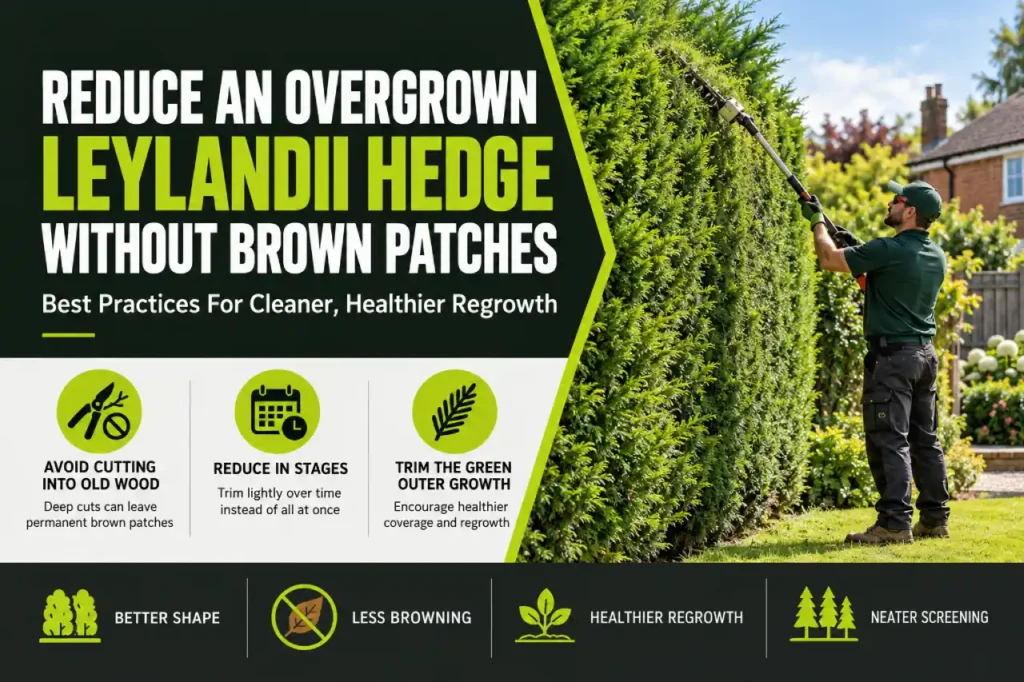
Quick answer: Yes, an overgrown Leylandii hedge can often be reduced without leaving large brown patches, but only if enough green foliage is retained. Leylandii generally does not regrow reliably from old, bare wood, so cutting the sides too far back can expose permanent brown areas. Height reduction is often more achievable, although very large reductions may need to be carried out gradually.
Leylandii is popular in gardens across Bournemouth, Poole, Christchurch, Ferndown and the wider Dorset area because it grows quickly and creates an effective evergreen screen.
That rapid growth can also become its biggest drawback.
A hedge that was once easy to maintain can gradually become several metres tall, spread far beyond its original boundary and block light from neighbouring areas. By the time it needs a major reduction, simply cutting it back to the preferred dimensions may no longer be possible without damaging its appearance.
Understanding where Leylandii can regenerate is therefore essential before deciding how much to remove.
Why Does Leylandii Turn Brown When It Is Cut Back?
The green outer layer of a Leylandii hedge can hide older branches underneath.
When a hedge is trimmed regularly, new foliage grows around the outside while the shaded interior becomes increasingly woody and bare. This is normal.
The problem occurs when pruning goes through that green outer growth and exposes the old, leafless wood underneath.
Unlike some hedge plants, Leylandii has very limited ability to produce new shoots from this older bare growth. Once a large brown section has been exposed, simply waiting for it to turn green again may not work.
This is why reducing an established Leylandii is very different from cutting back plants such as some deciduous hedges that can respond well to harder renovation pruning.
Before reducing the hedge, you need to know where healthy green growth finishes and old wood begins.
How Far Can You Safely Reduce an Overgrown Leylandii Hedge?
There is no single measurement that works for every hedge.
The safe amount depends on:
- The existing height and width
- How much green foliage remains
- The age and condition of the hedge
- How regularly it has previously been maintained
- Whether reduction is needed on the top, sides or both
- The health and vigour of the individual plants
- The final shape you are trying to achieve
The most important principle is to retain green growth wherever possible.
Reducing the Height
Height reduction is often more practical than a major reduction in width.
Healthy Leylandii can usually tolerate a measured reduction in height, provided the work does not remove an excessive proportion of the hedge at once.
For a very tall hedge, reducing it gradually may produce a better result than attempting one severe cut.
A professional assessment should consider not only the requested finished height but also whether the remaining plants will have enough healthy foliage to continue growing strongly.
The finished top may initially look flatter or less dense after a substantial reduction. New growth can gradually soften the appearance where viable green foliage remains.
Reducing the Width
Width reduction requires greater caution.
The sides of an established Leylandii hedge often contain a relatively thin layer of green growth surrounding an older woody interior.
Cut through that green layer and the result can be a large brown surface that does not reliably regenerate.
This means an extremely wide Leylandii hedge cannot always be narrowed to the dimensions a homeowner originally had in mind.
Sometimes the realistic choice is between retaining slightly more width than desired or considering removal and replacement.
Why Height and Width Reduction Are Different
From the outside, reducing the top by a metre and reducing each side by a metre might appear to be equivalent.
Biologically, they may produce very different results.
The top can contain suitable growing points below the intended reduction line, while the sides may contain only a shallow covering of foliage over bare branches.
That is why the hedge should be inspected before the final dimensions are agreed.
Can Brown Leylandii Grow Back?
It depends on what has caused the browning.
If trimming has exposed genuinely old, leafless wood, substantial new growth from that area is unlikely.
However, not every brown patch in a Leylandii hedge is caused by over-pruning.
Browning can also be associated with:
- Drought or prolonged dry conditions
- Waterlogging
- Cold or drying winds
- Cypress aphid
- Root problems
- Fungal disease
- General plant stress
- Trimming during unsuitable conditions
A patch that has turned brown because the foliage is stressed should therefore not automatically be treated in the same way as bare wood exposed by excessive cutting.
Look at where the damage occurs, whether individual branches or whole plants are affected and whether there is still live green growth around the area.
If the cause is unclear, diagnosis should come before further pruning.
Is It Better to Reduce a Large Leylandii Hedge in Stages?
For some very overgrown hedges, yes.
Trying to restore a hedge that has been neglected for many years in a single visit can involve removing too much living material.
A staged approach can allow the hedge to recover before another reduction is considered.
For example, a substantial height reduction may be completed first while the sides remain within viable green growth. The hedge can then be monitored through another growing period before further work is considered.
Staging does not solve every problem.
If the hedge is already excessively wide and there is no green foliage near the desired boundary, waiting another year will not necessarily make hard pruning into bare wood safe.
The value of staged reduction is therefore determined by the hedge’s existing structure rather than simply by its size.
When Is the Best Time to Reduce Leylandii in the UK?
Timing matters, particularly when significant work is required.
The Royal Horticultural Society recommends pruning Leyland cypress during the growing season, broadly between April and the end of August, and identifies early April as a suitable period for reducing an overgrown hedge as new growth is beginning.
Very hot, dry periods are best avoided because the hedge may already be under environmental stress.
Major late-season cutting is also undesirable.
If you only need routine seasonal maintenance rather than major reduction, our separate guide to when to trim hedges explains how timing varies between hedge types.
There is another consideration that is more important than the calendar alone: wildlife.
Check for Active Bird Nests Before Cutting
Hedges provide important nesting habitat.
Before hedge work begins, check carefully for active nests. Under the Wildlife and Countryside Act 1981, it is an offence to damage or destroy a wild bird’s nest while it is being built or used.
Bird nesting activity is commonly associated with spring and summer, but an active nest remains the important consideration rather than assuming work is automatically safe on a particular calendar date.
If an active nest is found, work affecting it should be postponed until it is no longer in use.
This should form part of planning any significant Leylandii reduction.
What Should You Check Before Cutting an Overgrown Leylandii?
A useful assessment involves more than deciding how many centimetres to remove.
How Much Green Growth Remains?
Look through the outer foliage and determine where woody growth begins.
A hedge with a deep healthy green layer provides more scope for reshaping than one with foliage concentrated only at the tips.
Is the Hedge Healthy?
Extensive dieback, weak growth or individual dead trees can change what is realistically achievable.
Reducing an already stressed hedge severely may worsen its condition.
Are There Active Bird Nests?
Inspect the hedge before using machinery or disturbing dense foliage.
If there is evidence of nesting activity, stop and assess the situation before work continues.
Can the Hedge Be Accessed Safely?
Tall Leylandii often presents a different challenge from an ordinary garden hedge.
Consider:
- Hedge height
- Ground conditions
- Garden access
- Nearby buildings
- Fences and sheds
- Greenhouses
- Roads and pavements
- Overhead obstacles
- Space required for equipment
- The quantity of material being removed
A substantial Leylandii reduction can generate far more green waste than its appearance suggests.
How Professionals Reduce an Overgrown Leylandii Hedge
The aim should not simply be to cut the hedge as small as possible.
A more considered approach begins by establishing the achievable finished dimensions.
The hedge is inspected for green growth, bare wood, dead sections and general condition. The required height and width are then compared with what the hedge can realistically tolerate.
Where substantial work is possible, reduction can be carried out while keeping viable foliage where needed.
The shape also matters.
A hedge that becomes wider at the top can shade its lower foliage and encourage thinning near the base. Maintaining a slightly broader base helps light reach more of the hedge.
For homeowners dealing with a large or difficult boundary, professional hedge trimming can also address access, safe working height and removal of the resulting cuttings.
What If the Leylandii Hedge Has Become Too Wide?
This is often the hardest problem to correct.
Imagine that a hedge currently projects 1.5 metres into the garden, but the healthy green foliage is concentrated within the outer 20 or 30 centimetres.
Reducing the hedge by only that green depth may improve the situation.
Trying to remove a full metre could expose the bare structural branches underneath.
In that situation, there are several possible outcomes.
You may accept a wider hedge and maintain it carefully from that point onwards.
A limited staged reduction may be considered where its structure allows.
Individual gaps may occasionally be disguised by training nearby healthy growth across them, although this is unlikely to restore very large bare areas quickly.
If the hedge occupies far more space than the garden can reasonably accommodate, removal and replacement may ultimately offer a better long-term solution.
When Is Removal More Sensible Than Reduction?
Not every Leylandii hedge should be retained at all costs.
Removal may deserve consideration when:
- The required width cannot be achieved without exposing extensive bare wood
- Several plants are already dead or declining
- The hedge has become disproportionate to the available garden
- It repeatedly blocks important light or access
- Long-term maintenance at its present dimensions is impractical
- The desired boundary can be achieved more effectively with another hedge or screening solution
That does not mean every large Leylandii needs removing.
Many established hedges can remain effective privacy screens for years when their dimensions are brought under control carefully and then maintained consistently.
The important question is not simply, “Can we cut it?”
It is, “What will the hedge look like afterwards, and is that result sustainable?”
Keeping Leylandii Manageable After Reduction
The easiest way to prevent another major renovation is regular maintenance.
Once the hedge has been reduced to a manageable size:
- Set a realistic maximum height and width.
- Trim new growth rather than waiting for woody growth to develop.
- Avoid repeatedly allowing the hedge to extend beyond the intended boundary.
- Keep the base slightly wider than the upper section where appropriate.
- Monitor developing brown patches rather than simply cutting through them.
- Check the hedge following drought, severe weather or other periods of stress.
- Plan maintenance before access becomes difficult again.
Routine cutting removes relatively young foliage.
Correcting ten years of unchecked growth is a completely different task.
That distinction is particularly important with Leylandii because the woody interior gives you very little margin for error.
Leylandii Hedge Reduction in Bournemouth, Poole, Christchurch and Ferndown
Leylandii is commonly used as a privacy and boundary hedge around homes across Bournemouth, Poole, Christchurch, Ferndown and neighbouring areas of Dorset.
The practical challenge varies considerably between properties.
A hedge alongside a large rear garden may have enough room to retain more width, while one beside a narrow Bournemouth garden, driveway or neighbouring boundary may need tighter management.
Access can also influence the work. Rear gardens, narrow side passages, extensions, sheds and neighbouring structures all affect how tall hedge reduction can be approached.
Tree Solutions provides hedge trimming and overgrown hedge reduction for residential and commercial properties across Bournemouth, Poole, Christchurch and surrounding areas.
Where a Leylandii hedge has grown beyond manageable proportions, the first step should be to establish what reduction is realistically achievable before cutting begins.
Frequently Asked Questions
Can Leylandii Grow Back From Brown Wood?
Generally, you should not rely on Leylandii producing new growth from old, bare wood. This is why substantial side reductions need particular care.
Can I Cut a Leylandii Hedge in Half?
It depends on its current size, condition and where healthy growth remains. Removing half of a very large hedge in one operation could be excessive. A staged reduction or a smaller final reduction may be more appropriate.
How Much Height Can You Take Off a Leylandii Hedge?
Healthy Leylandii may tolerate a meaningful height reduction, but there is no safe universal measurement. The RHS advises that healthy overgrown plants will usually respond to a reduction of up to around one-third of their height. Larger reductions require considerably more caution.
Will Brown Patches Fill In?
Small gaps may become less noticeable as nearby healthy shoots extend around them. Large areas of exposed old wood should not be expected to regenerate in the same way as ordinary green growth.
Why Has My Leylandii Turned Brown Even Though It Wasn’t Cut Hard?
Pruning is only one possible cause. Drought, waterlogging, cold winds, root problems, cypress aphids and some diseases can also cause browning. The pattern and condition of the affected growth should be assessed before deciding what to do next.
How Often Should Leylandii Be Trimmed?
Regular light trimming during the suitable growing period is preferable to allowing the hedge to become heavily overgrown. The precise frequency depends on its growth rate and the size you want to maintain.
Can Leylandii Be Cut During Bird Nesting Season?
There is no simple calendar rule that makes ordinary domestic hedge cutting automatically unlawful for an entire season. However, active wild bird nests are legally protected while they are being built or used. Always check carefully before hedge work begins and postpone work that would damage or destroy an active nest.
Need Advice About an Overgrown Leylandii Hedge?
An overgrown Leylandii does not automatically need to be removed, but the achievable reduction should be established before the first cut is made.
If too much is removed from the sides, the result can be permanent brown areas. If the hedge is reduced carefully and enough healthy foliage remains, it can often be brought back to a more manageable size and maintained there.
For homeowners and property managers in Bournemouth, Poole, Christchurch, Ferndown and surrounding areas, Tree Solutions can assess overgrown Leylandii and recommend an appropriate approach based on the hedge’s size, condition, access and the result you want to achieve.