
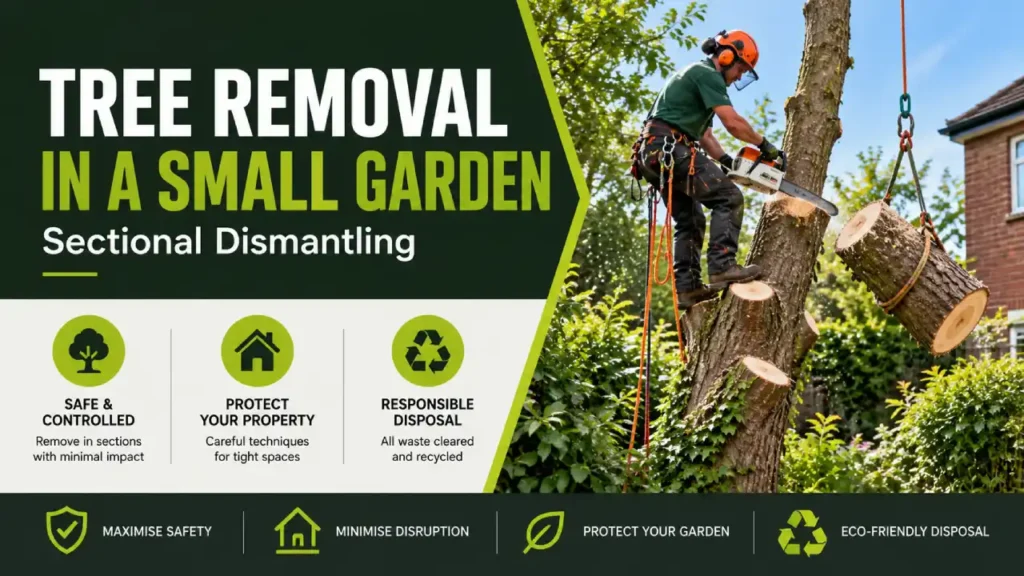
A large tree can become difficult to manage when there is barely enough room to walk around it, let alone fell it. Tree removal in a small garden often involves sectional dismantling: a professional tree surgeon takes the tree down in manageable pieces rather than allowing it to fall in one go. Branches and sections of trunk may be lowered using specialist ropes and rigging equipment. The method depends on the tree’s condition, available access and what needs protecting below. It gives homeowners a way to understand a job that might otherwise look impossible from ground level.
Why Is Removing a Large Tree From a Small Garden Difficult?
In an open area, a suitable tree may be felled in one piece. A small back garden is different. There may be a conservatory beneath the branches, a shed beside the trunk, fences on three sides and a neighbour’s garden only a few feet away.
Access presents another problem. A narrow passage between houses may rule out larger machinery, and timber cannot always be carried straight to a vehicle. A tree surgeon needs to consider not only the tree’s height and spread but also how people, equipment and cut material can move safely through the site. A side gate may be wide enough for branches carried by hand, but too narrow for the machinery that would make an open site job quicker.
What Is Sectional Tree Dismantling?
Sectional tree dismantling means removing a tree in stages, usually beginning with branches in the upper crown and working down through the trunk. Instead of bringing down the entire tree, the team deals with smaller sections according to the space and conditions around it.
Sections may be lowered using rigging ropes or moved into a suitable clear area. Sectional removal is not automatically required for every garden tree. If there is sufficient space, straightforward felling may be a suitable option.
Unlike crown reduction or thinning, which retain the tree, sectional dismantling removes it. If you are unsure whether removal is necessary, our guide to crown reduction, thinning and lifting explains the alternatives.
When Is Sectional Dismantling Necessary?
A tree surgeon may recommend sectional tree removal where a full fall would bring branches or the trunk too close to a house, garage, glass roof, boundary wall or neighbouring property.
Even with easy road access, a terraced house may leave no suitable landing space and require timber to be carried through a side gate.
The decision is not based on garden size alone. A professional also has to judge whether the tree is stable enough for climbing and whether another method, such as an access platform or specialist lifting arrangement, is more suitable.
How Do Tree Surgeons Remove a Tree in Sections?
The process usually follows five stages.
1. Assessing the Tree, Garden and Available Access
Before work begins, the team assesses the tree’s size, lean, condition and position. They look for weak limbs or decay, check nearby structures and consider obstacles such as overhead cables. The access route must also accommodate people and timber.
A site-specific plan determines what work is practical and how risks will be controlled. The Health and Safety Executive advises that tree-climbing operations need competent workers, risk assessment, appropriate planning and emergency arrangements.
2. Planning the Working Area and Protecting Nearby Structures
The team identifies where people can work and where material can be placed or moved. Areas beneath the operation need to be kept clear, and vulnerable surfaces may need suitable protection.
No responsible contractor can promise that a complex operation carries no risk. The purpose of careful planning is to manage foreseeable hazards and minimise avoidable damage.
3. Removing and Lowering Branches in Controlled Sections
Where climbing is appropriate, a trained arborist works through the crown while ground staff support the operation. Depending on the circumstances, sections may be secured and lowered using ropes, rigging blocks and lowering devices.
Heavy branches can therefore be controlled rather than dropped onto a patio or conservatory, subject to the site assessment.
4. Dismantling the Remaining Tree Trunk
Once the crown has been dealt with, the remaining trunk can be reduced in sections. Where clearance is tight, even the lower pieces may need controlled handling.
This is specialist work at height, not a suitable DIY task.
5. Clearing Branches, Timber and Other Tree Waste
After dismantling, branches and logs need to be processed, stacked or removed as agreed. Ask whether the quotation includes chipping, timber disposal and clearing smaller debris.
The stump normally remains unless its removal is included separately. If you want to reclaim the planting area, discuss professional stump grinding before the work is booked.
Can a Tree Be Removed When Machinery Cannot Access the Garden?
Often, yes, although the method must be decided after a proper site assessment. Lack of vehicle access does not necessarily make removal impossible. Depending on the tree and surrounding structures, qualified arborists may be able to work using climbing and rigging techniques while timber is moved out in smaller pieces.
An access platform or crane may help in some cases, depending on ground conditions and access.
If your only entrance is a narrow side gate, mention its approximate width when contacting a contractor. Photos help with initial enquiries but cannot replace a site assessment.
How Are Conservatories, Fences and Neighbouring Gardens Protected?
A tree overhanging a conservatory or neighbour’s roof needs particular care because there may be little room beneath the branches. Cut sections need carefully planned routes away from vulnerable structures.
Protection might include controlled lowering, keeping the work area clear and planning how timber travels through the garden. A good discussion before work starts should cover where logs will be placed, whether plants must be moved and which surfaces need particular attention.
Be upfront about fragile paving, hidden drains, recently installed decking or anything else that could be affected. If access through a neighbour’s property is proposed, their permission should be agreed in advance. A clear written plan helps avoid misunderstandings about what will and will not be protected.
What Affects the Cost and Time Needed for Sectional Tree Removal?
Removing a tree in sections may take more labour and planning than felling one in an open space. The quotation will depend on its height and condition, how close it stands to buildings, the working method, access for equipment and how timber will be handled.
A narrow gate does not automatically mean a high price, and a tall tree does not always require a crane. Ask whether the quote allows for extra time carrying timber through the property and any precautions needed to keep the access route usable.
For more, read our guide to what affects the cost of tree removal. A good quote clearly explains what is included.
Do You Need Permission Before Removing a Tree in a Small Garden?
Possibly. Tree protection applies regardless of whether the garden is large or small. A tree covered by a Tree Preservation Order generally needs consent before removal unless a relevant exception applies. For certain trees in conservation areas, the usual requirement is to give the local planning authority six weeks’ notice.
BCP Council is the relevant planning authority for Bournemouth, Poole and Christchurch. Ferndown and Wimborne are under Dorset Council, while Ringwood generally falls under New Forest District Council. Check the property address. Do not assume a tree can be removed simply because it is on privately owned land; restrictions can apply to trees in domestic gardens.
You can consult BCP Council’s guidance on trees in conservation areas and our existing guide to tree preservation laws for more background. Active bird nests must also be protected.
Small-Garden Tree Removal in Bournemouth, Poole and Christchurch
The challenge is often the layout of the property rather than the postcode. A garden in Winton may have a narrow side passage; a property in Westbourne or Parkstone may have a mature tree close to an extension or boundary.
Across Bournemouth, Poole and Christchurch, a sensible starting point is the same: establish why removal is needed, check restrictions and arrange an assessment of the tree and available working space. If the tree can be retained safely, ask about suitable alternatives before deciding on removal.
What Should You Ask a Tree Surgeon Before Booking?
Before accepting a quotation, ask what method is proposed and why. Will the tree be dismantled in sections? Is access to a neighbouring garden required? How will nearby structures and planting be considered?
Check the contractor’s relevant qualifications, insurance and arrangements for managing work at height. Confirm timber clearance and stump grinding in writing so quotes can be compared.
For advice on a difficult-access tree, contact Tree Solutions with a description of the garden and any photographs you can share. Include an approximate tree height, whether any branches overhang buildings and where the nearest practical entrance is. These details make the first conversation more useful.
Frequently Asked Questions About Sectional Tree Removal
Can you remove a large tree through a narrow side gate?
It may be possible. A narrow gate can limit equipment access, but a tree can sometimes be dismantled into sections and the wood taken out in smaller loads. The method depends on the tree and available working space.
Can a large tree be removed without a crane?
Yes, many trees can be removed using professional climbing and rigging methods without a crane. However, some trees are unsuitable for climbing or have obstacles that call for another approach. An assessment is essential.
Will a tree surgeon need access to my neighbour’s garden?
Not necessarily. Some jobs can be completed wholly from your property. Others may benefit from additional access. If your neighbour’s land is needed, permission and practical arrangements should be agreed beforehand.
How long does sectional tree dismantling usually take?
There is no reliable fixed duration for every job. Tree size, condition, access, rigging requirements and how waste is removed can all change the timescale. Ask the contractor for a realistic estimate after inspecting the site.
Does sectional tree removal include stump grinding?
Not automatically. Sectional dismantling concerns the parts of the tree above ground, while stump grinding deals with the remaining stump. Some quotations cover both and others do not. Confirm both items in the written quotation.
Planning the Right Approach for Your Garden
A small garden does not necessarily prevent a large tree from being removed. It does mean that access, surrounding property, tree condition and the removal method need careful thought. Sectional dismantling offers a way for professional teams to work in stages where conventional felling is unsuitable. Before booking, check the removal method, permissions, waste clearance and stump arrangements.