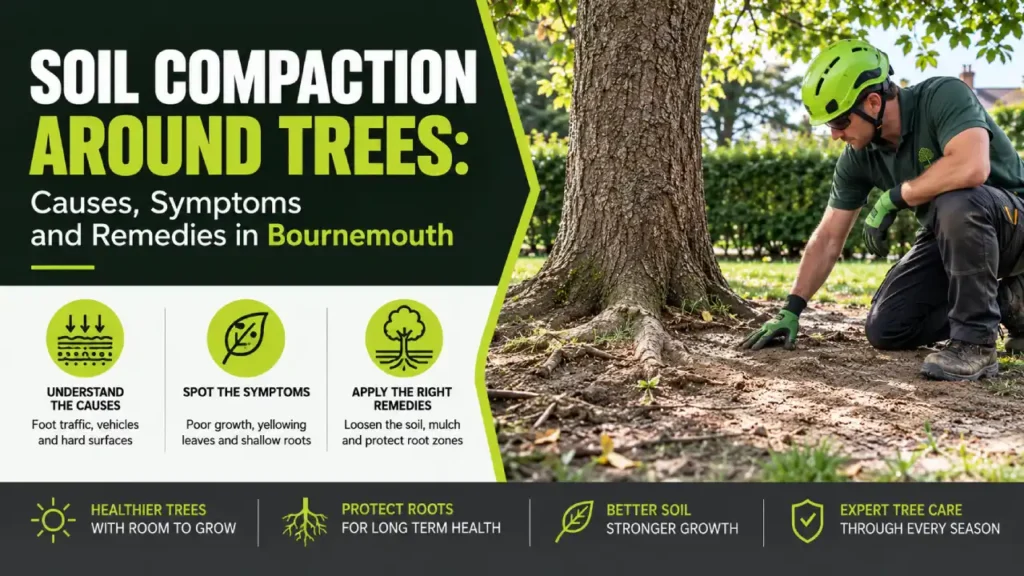
Soil compaction around trees happens when pressure squeezes the soil particles together and reduces the spaces that normally hold air and water. Tree roots then struggle to breathe, absorb moisture and spread into the surrounding ground. Early signs can include slow growth, smaller leaves, premature leaf fall, a thinning canopy and water collecting or running off the soil surface.
The safest first step is to stop whatever is placing pressure on the root zone. Avoid parking, repeated walking and machinery beneath the canopy. Do not automatically dig or drive a garden fork into the soil, as this can damage fine roots and turn a soil problem into physical root injury.
What Happens When Soil Becomes Compacted?
Healthy soil is not a solid mass. It contains spaces between its particles through which oxygen, water and roots can move.
Compaction reduces that pore space. The soil becomes denser, harder for new roots to penetrate and less effective at moving air and water.
Forest Research explains that compacted soil can cause two problems that appear contradictory. During wet periods, water may drain poorly and create waterlogging. During dry conditions, limited root development and poor water movement can contribute to drought stress. Weak root development may also affect a tree’s stability during storms.
This means soil compaction around trees is not simply a drainage problem. It can affect:
- Root growth
- Oxygen availability
- Water infiltration
- Nutrient uptake
- Canopy development
- The tree’s response to drought
- Long-term anchorage
The effects may develop gradually. A mature tree can continue producing leaves while its rooting environment becomes progressively less supportive.
What Causes Soil Compaction Around Trees?
Repeated Foot Traffic
Walking across the same area repeatedly presses the soil particles together, particularly where people take a shortcut beneath the canopy.
One or two people crossing healthy dry ground occasionally are unlikely to cause serious damage. The concern is repeated use, especially when the ground is wet.
Common examples include:
- A path to a shed or gate
- Children playing beneath a tree
- Regular access to bins
- Customers crossing a commercial garden
- Repeated maintenance around the trunk
Cars and Other Vehicles
Parking a car, van, trailer or machinery beneath a tree places considerably more pressure on the ground than normal foot traffic.
The roots may not be visibly broken, but the soil surrounding them can be compressed. Repeated vehicle use can create a dense layer that restricts root growth and water movement.
Tyre ruts and areas where grass no longer grows can provide clues that the root zone has been subjected to excessive traffic.
Building and Landscaping Work
Extensions, driveways, patios, fencing, drainage work and garden redesigns can all affect the ground around established trees.
Compaction may be caused by:
- Excavators
- Material deliveries
- Stored paving slabs
- Skips
- Cement mixers
- Repeated wheelbarrow routes
- Contractors working over wet soil
- Temporary site access
Forest Research identifies construction activity as a common source of compaction and root damage around urban trees.
A tree can begin declining months or years after the work, making the connection easy to miss.
Working Wet Ground
Wet clay and silty soils are particularly vulnerable because pressure can damage their structure more readily.
The RHS advises avoiding walking on or working wet soil around declining trees and shrubs. It identifies heavy foot traffic and machinery as common compaction causes.
Heavy Objects Stored Beneath a Tree
Soil can also be compacted when heavy materials remain within the root zone for weeks or months.
Examples include:
- Logs
- Building materials
- Garden machinery
- Large containers
- Soil bags
- Play equipment
- Temporary structures
The affected area may extend further from the trunk than expected because many absorbing roots occur beneath and beyond the canopy.
Poor Preparation Before Planting
New trees can struggle where the surrounding ground was compacted before planting.
A planting hole may contain loose soil, but the roots can fail to move into the denser ground beyond it. The tree then behaves as though it is still confined to a container.
The RHS notes that new roots normally develop laterally through the upper soil layers. Compacted surrounding ground can prevent that outward growth.
Are Bournemouth Garden Soils Particularly Vulnerable?
Bournemouth does not have one uniform soil type.
The British Geological Survey describes the local Branksome Formation as containing substantial fine to coarse sand, together with mixed sediments and clay lenses. Individual gardens may also contain imported topsoil, compacted subsoil, rubble or ground altered during previous construction.
Sandy ground can still become compacted, particularly where it contains finer material or has been compressed by machinery. Clay and silty ground is generally more vulnerable to structural damage, especially when wet.
Local conditions should therefore be assessed at the property rather than assumed from the postcode.
A Bournemouth garden may contain:
- Fast-draining surface soil over dense subsoil
- Sandy soil mixed with construction material
- Clay pockets that hold water
- Imported topsoil above compacted ground
- Previously paved areas converted into planting beds
These combinations can cause water to behave unpredictably around a tree.
Signs of Soil Compaction Around Trees
No single symptom confirms compaction. The tree, soil and recent history must be considered together.
Slow or Short New Growth
A tree growing in restricted soil may produce shorter annual shoots than it did previously.
Compare current growth with older shoots and with similar branches elsewhere in the canopy.
Smaller or Paler Leaves
Poor root function can reduce the tree’s ability to support vigorous foliage.
Leaves may appear:
- Smaller than usual
- Pale green
- Yellow between the veins
- Sparse
- Less vigorous
These symptoms can also be caused by drought, disease and nutrient problems.
Premature Leaf Fall
A stressed tree may shed leaves before autumn because its roots cannot support the full canopy.
Premature leaf fall does not prove soil compaction around trees, but it becomes more significant when combined with hard ground, recent construction or repeated traffic.
Canopy Thinning
More daylight may become visible through the crown. The thinning may affect the entire canopy or appear more strongly above one part of the root zone.
Localised decline can sometimes correspond with an area affected by paving, excavation or parked vehicles.
Branch Dieback
More advanced root stress may result in dead twigs and branches, often beginning towards the tips of the canopy.
Large-scale or rapidly developing dieback requires professional assessment because structural defects, fungal disease and root decay may also be involved.
Water Pooling or Running Off
Compacted ground may accept water slowly.
After rainfall or watering, you may notice:
- Puddles remaining on the surface
- Water flowing towards another area
- A sealed or crusted soil surface
- Water collecting beside paving
- Very dry ground beneath a briefly wet surface
Compaction can restrict both infiltration and drainage, which is why the same site may appear waterlogged during winter and dry during summer.
Bare, Hard Ground
Grass and other plants may struggle beneath a heavily used tree because the ground is hard, shaded and repeatedly walked over.
Bare ground alone is not enough to diagnose compaction. Heavy shade, dry soil and root competition can produce a similar appearance.
Is It Compaction, Drought or Waterlogging?
| Observation | Soil compaction | Drought stress | Waterlogging | Root damage or disease |
|---|---|---|---|---|
| Hard soil surface | Common | Possible when very dry | Less typical | Not diagnostic |
| Water pools after rain | Common | Unlikely by itself | Common | Possible |
| Tree wilts despite wet ground | Possible | Less likely | Common | Possible |
| Decline after building work | Strong clue | Possible secondary issue | Possible | Strong clue |
| Reduced shoot growth | Common | Common | Common | Common |
| Symptoms mainly on one side | May match compacted area | Possible | Possible | May match severed roots |
| Fungal brackets at the base | Not caused by compaction alone | Not typical | May accompany decay | Important warning sign |
| Soil dries rapidly | Possible where roots are restricted | Common | Less likely | Possible |
Compaction can also contribute to both drought and waterlogging. The conditions are not always separate.
How Can You Check for Compacted Soil?
Begin with the history of the site.
Ask:
- Has a vehicle been parked beneath the tree?
- Was a patio or driveway installed nearby?
- Has the garden recently been landscaped?
- Were materials stored beneath the canopy?
- Is the area used as a regular path?
- Did contractors work while the ground was wet?
- Has the soil level changed around the trunk?
Next, inspect the entire tree from a safe distance. Look for canopy thinning, reduced new growth and whether symptoms are concentrated above a particular section of ground.
The soil surface can provide supporting clues, but a simple screwdriver or garden-fork test is not conclusive. Naturally dry soil may feel hard, while recently wet surface soil may conceal a denser layer below.
Professional assessments may use soil probes, penetration measurements, root investigation or compressed-air excavation to understand the extent and depth of the problem.
How to Remedy Soil Compaction Around Trees
The right remedy depends on the severity, depth and cause of the compaction.
Stop the Cause First
Treatment has little value if vehicles or people continue crossing the same ground.
Possible changes include:
- Redirecting a path
- Moving parking elsewhere
- Installing a low boundary around the root zone
- Relocating play equipment
- Creating a designated access route
- Keeping machinery outside the canopy area
- Preventing storage beneath the tree
A wider protected area is generally more useful than protecting only the ground beside the trunk.
Do Not Rotavate or Dig Deeply
A rotavator, spade or garden fork can cut fine roots and damage larger structural roots.
The RHS advises avoiding cultivation around established plants because digging can harm their root systems.
Do not drill holes, create trenches or drive spikes into the root zone without a clear professional plan.
A treatment that improves the soil but destroys roots is not a successful remedy.
Reduce Grass Competition
Where appropriate, grass can be removed carefully from part of the main rooting area.
This reduces:
- Competition for water
- The need for mowing
- Foot traffic
- Strimmer damage
- Repeated access close to the trunk
Avoid stripping turf with machinery or cutting deeply into surface roots.
Apply Organic Mulch Correctly
An organic mulch can protect the surface from further compaction, reduce evaporation and support biological activity that gradually improves soil structure.
The RHS recommends organic mulch as part of the long-term management of compacted ground around declining trees.
Spread mulch broadly and keep it clear of the trunk and root flare.
Do not create a deep mound against the bark. Mulch helps the root zone, but it is not an instant cure for severe or deeply compacted soil.
Manage Water According to Actual Soil Moisture
Compacted soil can be wet near the surface while roots remain poorly supplied with oxygen and usable water.
Check the soil before watering.
Where the root zone is dry, water slowly so it has time to enter the ground. Where the soil remains saturated, adding more water may worsen root stress.
Consider Professional Air-Spade Treatment
An air spade uses compressed air to loosen or remove soil while reducing the risk of cutting woody roots with metal digging tools.
It may be used to:
- Investigate roots
- Expose the root flare
- Remove excess soil
- Loosen compacted areas
- Incorporate suitable soil improvements
- Examine construction damage
The RHS identifies compressed-air tools as a possible treatment for significant compaction around valuable trees. Forest Research notes that air injection can reduce compaction after tree establishment, although results depend on soil type and clay soils may compact again.
Air-spade work is not automatically required in every hard garden. The tree, roots, soil and likely benefit should be assessed first.
What Should You Avoid?
Adding Fertiliser Without Diagnosing the Problem
Yellow or small leaves do not necessarily indicate a nutrient shortage.
The RHS explains that poor nutrient uptake in established trees is often caused by growing conditions such as compaction, drought or waterlogging rather than an actual lack of fertiliser.
Feeding does not restore missing pore space or repair damaged roots.
Covering the Area With More Soil
Raising the soil level can reduce oxygen around existing roots and bury the root flare.
Do not attempt to improve compacted ground by simply spreading a deep layer of topsoil over it.
Installing Paving Without Root Protection
Placing paving directly over the root zone can introduce further pressure and reduce the amount of open soil available for water and air movement.
Tree protection should be planned before the work begins, not after signs of decline appear.
Cutting Roots to Make Soil Work Easier
Roots should not be severed because they obstruct digging, edging or landscaping.
Cutting major roots can affect water uptake, tree health and structural stability.
Can a Tree Recover From Soil Compaction?
Recovery depends on:
- The severity of the compaction
- How deeply it extends
- The amount of healthy root area remaining
- Tree species and age
- Previous health
- Whether roots were physically severed
- How quickly the source of pressure is removed
- Whether the soil becomes compacted again
Mild surface compaction may improve gradually after traffic is stopped, turf is reduced and the ground is mulched.
A tree affected by heavy machinery, deep compaction or substantial construction damage may take several growing seasons to respond. Some canopy damage may not become clear until months after the original work.
Take photographs from the same positions and compare:
- Canopy density
- Leaf size
- Annual shoot growth
- New dieback
- Leaf-fall timing
- Soil conditions after rain
How to Prevent Soil Compaction Around Trees
Prevention is usually easier than treatment.
Before building or landscaping work:
- Identify the likely rooting area.
- Keep vehicles and stored materials away.
- Install suitable protective fencing or ground protection.
- Avoid activity while the soil is waterlogged.
- Explain the tree-protection area to every contractor.
- Do not change soil levels without arboricultural advice.
- Keep cement, chemicals and wash water away from the roots.
Compaction can occur before visible tree damage appears. Waiting for the canopy to decline means the roots may already have been affected.
When Should a Tree Surgeon Inspect the Problem?
Arrange professional advice when:
- Canopy thinning is becoming worse
- Large branches are dying
- The tree has developed a new lean
- The root zone was crossed by heavy machinery
- A driveway, patio or extension was recently installed
- Fungal brackets appear near the base
- Water remains around the tree for prolonged periods
- The root flare is buried
- Major roots have been exposed or severed
- The tree is close to a house, road or public path
- The tree is protected by a TPO or conservation area controls
An inspection should consider the whole tree rather than treating hard soil in isolation.
Frequently Asked Questions
How Can I Tell Whether Soil Around a Tree Is Compacted?
Look for a combination of hard or sealed ground, poor water infiltration, repeated traffic, slow tree growth, smaller leaves and canopy thinning. These signs are not exclusive to compaction, so the tree’s history and rooting environment must also be considered.
Can Soil Compaction Around Trees Kill Them?
Severe or prolonged compaction can contribute to root death and tree decline because it restricts oxygen, water movement and root development. The outcome depends on the affected area, depth, species and how quickly the cause is addressed.
Can I Loosen the Soil With a Garden Fork?
Deeply forking the soil around an established tree can damage roots. Low-risk surface improvements and mulch may help mild cases, but significant compaction should be assessed before mechanical treatment.
Does Mulch Fix Compacted Soil?
Mulch can protect the surface, reduce further pressure and gradually support better soil structure. It does not immediately reverse deep compaction or repair roots damaged during construction.
Why Does Water Pool Around a Compacted Tree?
Compacted soil contains fewer and smaller pore spaces, so water may enter and drain through it more slowly. Water can collect on the surface even though parts of the root system are not receiving suitable moisture or oxygen.
Is Clay Soil More Vulnerable to Compaction?
Clay and silty soils are generally more vulnerable, particularly when wet. Sandy and mixed soils can also become compacted under repeated pressure or heavy machinery.
What Is Air-Spade Soil Decompaction?
It is a professional technique that uses compressed air to loosen or remove soil around roots with less risk of cutting them than conventional digging. Its suitability depends on the tree and soil conditions.
How Long Does Recovery Take?
There is no fixed recovery period. Mild cases may show improved growth during a later growing season, while trees affected by deep compaction or construction damage can require longer monitoring and may not fully recover.
Concerned About the Ground Around a Bournemouth Tree?
Hard ground, standing water and a thinning canopy can indicate soil compaction around trees, but they can also result from drought, waterlogging, root damage or disease.
Tree Solutions can assess the tree, canopy and surrounding garden conditions before recommending whether the area needs monitoring, changes in garden use or further specialist investigation.
Early assessment is particularly important after driveway work, landscaping or repeated vehicle access near a mature tree.