
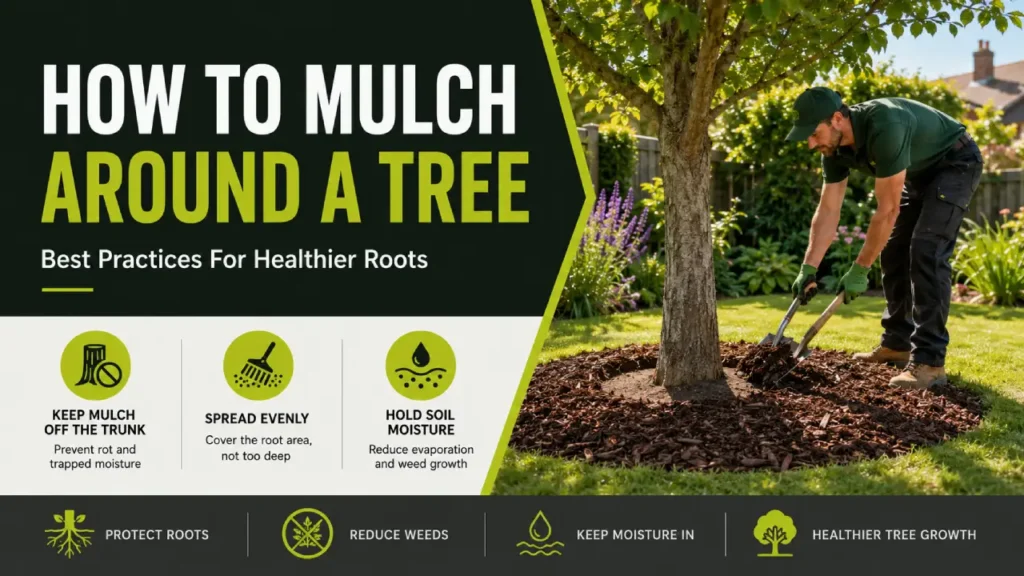
Mulch should form a broad, fairly flat layer over the soil around a tree, not a mound piled against its trunk. Keep the root flare visible, leave a clear gap around the bark and choose the depth according to the material you are using. Done properly, mulching can conserve moisture, reduce competition from weeds and grass, protect the soil and support healthier roots.
The mistake to avoid is the mulch volcano, where bark or woodchip is heaped into a cone around the trunk. It may look tidy, but the tree does not benefit from having damp organic material pressed against its bark.
What Is a Mulch Volcano?
A mulch volcano is a mound of mulch piled high against the base of a tree.
Instead of covering the soil around the roots, the material rises up the trunk. This can hide the natural root flare and keep bark in contact with a damp, low-oxygen environment.
Tree bark above ground is not designed to remain buried beneath moist organic material.
RHS guidance advises keeping mulch clear of tree trunks because direct contact can create conditions that encourage disease.
The correct shape is closer to a broad ring or shallow doughnut:
Wrong: narrow, deep and touching the trunk
Right: wide, relatively level and clear of the trunk
Why Mulching Can Be Particularly Useful in Bournemouth Gardens
Mulch is useful across Britain, but soil conditions make it particularly relevant in some Bournemouth gardens.
British Geological Survey records show that parts of Bournemouth are associated with the Branksome Sand Formation, which contains substantial sandy material alongside areas of silt and clay. Soil conditions still vary considerably between individual properties.
Where garden soil drains quickly, organic mulch can help reduce moisture loss from the surface during warm, dry weather.
It can also reduce competition from grass around newly planted trees.
The Forestry Commission recommends mulching as one way of helping young trees during prolonged dry conditions because it assists with weed control and maintaining soil moisture.
Mulching will not fix drought, root damage or poor planting, but it can improve the conditions immediately around healthy roots.
How to Mulch Around a Tree Correctly
1. Find the Root Flare First
Before opening the bag of mulch, look at where the trunk meets the ground.
A healthy planting position normally shows the trunk broadening as the main roots begin to spread outwards. This is the root flare, sometimes called the root collar area.
It should not disappear beneath a mound of soil or mulch.
If the trunk enters the ground like a straight pole with no visible flare, do not automatically add another layer of material. The tree may already be planted too deeply or have accumulated soil and mulch around its base.
RHS guidance on declining trees recommends removing excess material around the root collar where necessary so that the root flare can be exposed.
Large roots should not be cut or damaged simply to create a neater mulch ring.
2. Remove Grass and Weeds Carefully
Grass growing right up to a young tree competes for moisture and nutrients.
Clear a reasonable area around the trunk before applying mulch. Pull weeds by hand where possible and work carefully around visible roots.
Avoid digging deeply with a spade close to the tree. Fine absorbing roots often occur near the surface, so aggressive cultivation can damage the very root system the mulch is meant to protect.
For newly planted trees, reducing surrounding vegetation can make a significant difference during establishment. The Woodland Trust recommends keeping the area around young trees clear of weeds and long grass during their early years.
3. Check the Soil Moisture
Mulch slows moisture loss. It does not create water.
If the ground is very dry, water the root area before mulching rather than covering dry soil and hoping the problem corrects itself.
RHS advice for woody mulch recommends avoiding application onto dry soil where possible.
The soil should be moist, not waterlogged.
Where a tree is wilting despite consistently wet ground, adding mulch and more water may not be appropriate. Poor drainage, compaction or root problems may need investigation.
4. Choose an Appropriate Mulch
For trees, suitable organic materials can include:
- Wood chips
- Chipped bark
- Composted bark
- Leaf mould
- Well-rotted garden compost
The best option depends on whether the tree is newly planted or established and what material is available.
Wood Chips
Wood chips are particularly useful because their coarse structure allows them to create a long-lasting surface layer.
RHS guidance states that chipped or shredded woody material from both broadleaf and conifer sources can make useful mulch.
Fresh mixed woodchip can generally be used around established trees.
There is also little evidence that a surface layer of woody mulch causes meaningful nitrogen deficiency in established plants. Problems are more likely when woody material is dug into the soil, rather than left on the surface.
Fresh Woodchip Around Young Trees
Some fresh woody material can contain compounds that may affect young or establishing plants.
The RHS suggests ageing certain broadleaf and conifer chippings for around three to four months when they are to be used near newly established planting.
For a recently planted tree, aged woodchip or composted bark is therefore a straightforward option.
5. Get the Depth Right
More mulch is not automatically better.
The ideal depth depends partly on particle size.
RHS guidance suggests approximately:
| Mulch material | Typical depth |
|---|---|
| Garden compost or similar fine organic mulch | 5 to 7.5cm |
| Coarse woodchip | 8 to 12cm |
Coarse material can be deeper because the larger particles leave more air spaces and are less prone to compacting.
For a simple home-garden approach, aim for an even layer rather than repeatedly adding material until a mound develops.
Existing mulch should be checked before adding more.
If several centimetres remain from last year, topping it up with another full layer may gradually create excessive depth.
6. Keep Mulch Away From the Trunk
This is the most important step.
After spreading the material, pull it back from the tree trunk.
RHS woody-mulch guidance recommends an 8 to 10cm gap, while its broader tree-care guidance recommends leaving approximately 10 to 15cm around the trunk free of mulch.
You do not need to measure the gap with a ruler every time.
The principle is simple:
The mulch should cover soil, not bark.
The root flare should remain visible rather than disappearing beneath the material.
7. Make the Mulch Ring Wide, Not High
A broad ring is more useful than a narrow mound.
Tree roots extend outwards through the surrounding soil, often much further than the area immediately beside the trunk.
Where space allows, widen the mulch ring over the root area rather than increasing its depth.
For young trees, the Woodland Trust recommends a mulch area approximately one metre across to help control competing vegetation.
In a small Bournemouth garden you may not have enough space to mulch beneath the entire canopy. That is fine. Use the available soil area sensibly and avoid covering paving, drains or structures simply to achieve a particular diameter.
Correct Mulching vs a Mulch Volcano
| Correct mulch ring | Mulch volcano |
|---|---|
| Root flare visible | Root flare buried |
| Mulch spread over soil | Mulch piled onto trunk |
| Broad and fairly flat | Narrow and cone-shaped |
| Depth suited to material | New layers repeatedly piled on |
| Bark kept dry and exposed | Bark held against damp mulch |
| Soil protected | Trunk unnecessarily buried |
This comparison should also be turned into an original Treesol photograph or graphic for the published article.
Why Should Mulch Stay Away From Tree Bark?
Mulch is designed to help the soil and roots.
When kept permanently against the trunk it can create a damp environment around bark that would normally remain exposed to air.
Over time this can conceal:
- Decaying bark
- Root-collar problems
- Adventitious roots
- Girdling roots
- Pest activity
- Fungal growth
It can also make inspection difficult because the true base of the tree is hidden.
The issue is therefore not mulch itself. It is where and how it is applied.
Can You Correct an Existing Mulch Volcano?
Usually, the first step is to gently pull loose material away from the trunk.
Work from the tree outwards and spread the mulch across the surrounding soil until the layer is flatter.
Stop when you reach the actual soil level.
If the root flare becomes visible, leave it exposed.
Be More Cautious When You Find Roots Inside the Mulch
A mulch volcano that has existed for several years may contain roots growing through the accumulated material.
Do not start cutting those roots yourself simply because they look untidy.
Roots crossing or circling the trunk can become structurally significant, and removing the wrong root may create another problem.
Professional assessment is sensible when:
- The root flare cannot be found
- Large roots are circling the trunk
- The tree appears deeply planted
- Bark beneath the mulch is soft or damaged
- Fungal growth is present
- The tree has started declining
- Large roots would need removing
The problem may be deeper planting or historic soil build-up rather than mulch alone.
Do Mature Trees Still Benefit From Mulch?
Yes, particularly where the soil beneath the canopy is compacted, dry or heavily competed for by lawn.
Established trees do not necessarily need a decorative mulch ring to remain healthy, but appropriate mulching can help:
- Retain moisture
- Moderate soil conditions
- Reduce grass competition
- Protect exposed soil
- Reduce damage from mowers and strimmers
- Add organic matter over time
The same trunk-clearance rule applies to mature trees.
Do not bury an established root flare just because the trunk is larger.
What About Newly Planted Trees?
Mulching is especially useful during establishment.
Young trees have a limited root system and are more sensitive to competition from grass and prolonged dry conditions.
The Forestry Commission identifies the first 12 to 36 months after planting as an important establishment period in which water availability is critical.
A young tree therefore benefits from a clear, mulched root area, but the mulch should still remain away from the trunk.
Do not attempt to protect a new tree by burying the stem beneath extra mulch.
Common Mulching Mistakes
Adding a New Full Layer Every Year
Check what remains first.
Mulch decomposes gradually. You may only need to top it up rather than repeat the original application depth each spring.
Letting Mulch Touch the Bark
This creates the basic conditions for a mulch volcano even when the layer initially looks shallow.
Digging Woodchip Into the Soil
Woody material works well as a surface mulch.
The RHS notes that mixing large amounts of woody material into the soil can temporarily reduce nutrient availability because microorganisms use nitrogen while the material decomposes.
Covering Dry Soil
Water dry ground first where appropriate.
Mulching dry soil does not replace proper watering.
Hiding the Root Flare
The bottom of the trunk should widen naturally where it meets the root system.
If you cannot see that transition, investigate before adding more material.
Treating Mulch as a Cure
Mulch will not correct:
- Root rot
- Severe compaction
- Structural instability
- Damaged roots
- Poor drainage
- Incorrect planting depth
- Advanced disease
It improves the growing environment but does not replace diagnosis.
When Should a Tree Surgeon Look at the Base of the Tree?
Most homeowners can spread mulch safely themselves.
Professional advice becomes useful when removing an old mulch mound reveals something unexpected.
Ask a tree surgeon to inspect the tree when:
- Large roots are wrapped around the trunk
- The root flare remains buried beneath soil
- Bark at ground level is damaged
- Mushrooms or fungal brackets appear near the base
- The canopy is thinning
- The tree is leaning or unstable
- Major roots have been damaged by building or landscaping work
- You are unsure whether exposed roots should be covered or left alone
The aim is not to turn a simple gardening task into unnecessary tree surgery. It is to recognise when the problem beneath the mulch is more significant than the mulch itself.
Keep the Mulch Around the Roots, Not the Trunk
Mulching around a tree is straightforward once the purpose is clear. The goal is to protect and improve the soil where the roots are growing, not to bury the tree.
Spread the mulch wide, keep the layer appropriate for the material and leave the trunk and root flare exposed.
For Bournemouth gardens that dry quickly during warm weather, this simple approach can help conserve soil moisture while reducing competition around the tree.
If removing old mulch reveals buried roots, damaged bark or signs of decline, Tree solutions can inspect the tree and advise whether the issue needs further attention.
Frequently Asked Questions
How Deep Should Mulch Be Around a Tree?
For composted organic material, around 5 to 7.5cm is commonly suitable. Coarse woodchip can be deeper, with RHS guidance suggesting roughly 8 to 12cm. Avoid building repeated layers that become excessively deep.
How Far Should Mulch Be From the Tree Trunk?
Keep a clear space around the trunk. RHS guidance ranges from approximately 8 to 15cm depending on the application. The important point is that mulch should not sit directly against the bark.
Are Wood Chips Good Around Trees?
Yes. Wood chips can help retain moisture, protect soil and suppress competing vegetation. Keep them on the surface rather than digging them into the soil.
Can Fresh Tree Chippings Be Used as Mulch?
Fresh mixed woodchip can generally be used around established plants. Around new planting, ageing some woody materials before application may be preferable.
Should You Mulch Right Up to the Tree Trunk?
No. Leave the trunk and root flare exposed.
Can Too Much Mulch Damage a Tree?
Yes. Excessive depth and mulch piled around the trunk can create undesirable moisture conditions, hide the root flare and make root-collar problems harder to detect.
Should Grass Be Removed Before Mulching?
Removing grass around a young tree reduces competition for moisture and nutrients. Work carefully so that surface roots are not damaged.