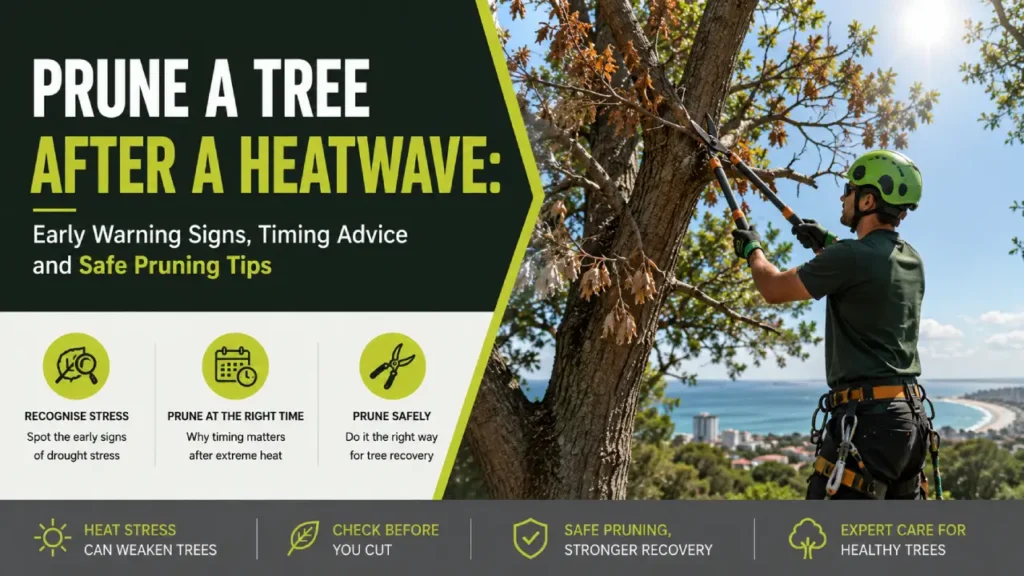
Routine or heavy pruning should not normally be carried out immediately after a heatwave. A heat-stressed tree needs time to rehydrate and reveal which leaves, buds and branches remain alive. Broken, split or hanging branches are the exception. These may present a safety risk and should be assessed promptly by a qualified tree surgeon.
Brown leaves alone do not prove that a branch is dead. A tree may shed leaves, develop scorched edges or reduce its canopy temporarily to conserve moisture. Cutting healthy growth too soon can remove foliage the tree needs for recovery and place further pressure on an already stressed system.
At a Glance: Should the Tree Be Pruned?
| What you can see | Recommended action |
|---|---|
| Curled, brown-edged or scorched leaves | Water appropriately, monitor and postpone routine pruning |
| Premature leaf fall without damaged branches | Allow time for recovery before deciding what to remove |
| A stable tree with planned crown reduction | Delay work until stress has eased and the timing suits the species |
| A small accessible dead twig | Monitor if there is no risk |
| A broken or hanging branch | Keep away and arrange a prompt assessment |
| A split major limb or sudden change in lean | Treat it as an urgent safety concern |
| Uncertain branch dieback | Ask a tree surgeon to distinguish deadwood from temporary heat damage |
Why Pruning Immediately After Extreme Heat Can Be Harmful
Pruning removes leaves and branches. Leaves produce energy through photosynthesis, while living branches store and transport resources through the tree.
After a heatwave, a tree may already be responding to:
- Dry soil
- High leaf temperatures
- Increased water loss
- Hot, drying winds
- Restricted root moisture
- Previous root damage
- Competition from grass and other plants
Removing healthy leaf-bearing material at this stage may reduce the tree’s ability to rebuild energy reserves. The Arboricultural Association advises that, in most circumstances, as little live material as possible should be removed unless there is a clear objective or hazardous defect. It also advises avoiding pruning when recovery may be impaired by physiological stress or drought.
This does not mean that all summer pruning is harmful. The correct timing depends on the species, the tree’s condition, the amount of work proposed and the reason for pruning.
What Does Heat Stress Look Like in a Tree?
A heat-stressed tree may display one or several of the following signs:
- Leaves curling or folding
- Wilting during the warmest part of the day
- Brown or scorched leaf margins
- Premature yellowing
- Early leaf drop
- Reduced new growth
- A thinner canopy
- Small leaves
- Developing branch dieback
- Dry soil beneath the surface
Weather damage can cause browning, wilting, dieback and leaf loss without necessarily killing the entire plant. The RHS advises allowing time before making irreversible decisions because live buds and branches may remain behind damaged foliage.
Symptoms must be considered together. Similar signs can result from waterlogging, fungal disease, damaged roots, compacted soil or pests.
Brown Leaves Do Not Always Mean Dead Branches
A leaf may become scorched when water is lost faster than the roots can replace it. The damaged part of that leaf will not become green again, but the branch supporting it may still be alive.
Before pruning, consider:
- Are buds still visible?
- Are smaller twigs flexible rather than brittle?
- Is the damage spread evenly across the canopy?
- Did the symptoms begin during or shortly after hot weather?
- Has new dieback continued after temperatures fell?
- Is the soil dry, wet or compacted?
- Has there been recent digging, paving or construction near the tree?
The RHS specifically advises resisting the impulse to prune woody plants immediately after heat-related leaf loss. Waiting can make it easier to distinguish temporary foliage damage from genuine deadwood.
Do not climb the tree or cut high branches to test whether they are alive. A visual assessment from ground level is safer. Large, elevated or structurally important branches should be examined professionally.
How Long Should You Wait Before Pruning?
There is no single waiting period that works for every tree.
Waiting seven or fourteen days may sound convenient, but the calendar alone does not show whether the tree has recovered. The right time depends on:
- Species
- Age
- Soil moisture
- Root condition
- Severity of heat damage
- Amount of planned pruning
- Whether the tree was healthy beforehand
- The next suitable pruning season
- Whether a branch presents an immediate hazard
Several cooler days do not automatically mean that the root zone has regained enough moisture.
Before considering routine pruning, look for these signs:
- The soil is no longer excessively dry
- Morning wilting has reduced
- Leaf drop has slowed or stopped
- New areas of dieback are not appearing
- The tree is structurally stable
- The proposed timing is suitable for the species
- No further severe heat is forecast
- The objective of the pruning remains necessary
Where the work is cosmetic rather than urgent, waiting until the tree’s condition becomes clearer is generally the safer choice.
When Should You Not Wait?
Heat stress does not prevent urgent safety work.
Request a prompt professional inspection when you notice:
- A broken branch suspended in the canopy
- A split limb
- A branch resting on a building, vehicle or cable
- Cracking where a major branch joins the trunk
- Fresh movement at the base
- A sudden or increasing lean
- Large dead branches above an occupied area
- Branch failure following dry or windy weather
- A tree blocking a road, path or access point
The aim of urgent work is to remove or reduce an immediate risk, not to carry out unnecessary reshaping while the tree is stressed.
Keep people, vehicles and pets away from the affected area. Do not stand beneath a damaged canopy or attempt high-level work with a ladder or domestic chainsaw.
Is It Ever Acceptable to Remove Deadwood?
Clearly dead, broken or dangerous wood may need to be removed, particularly where it could fall onto an occupied area.
However, apparent deadwood after a heatwave can be difficult to assess. Leaves may be lost while branches and buds remain viable. Where there is no immediate risk, monitoring may provide a more reliable picture of what has survived.
A tree surgeon should consider:
- The diameter of the branch
- Its position
- Whether it is completely dead
- The size of the wound that removal would create
- The tree species
- The tree’s overall vitality
- Nearby targets such as paths, buildings and parking areas
The Arboricultural Association recommends considering the effect of branch removal, the amount of leaf-bearing material lost and the size of the resulting wound before pruning.
Pruning Timing Varies by Tree Species
A heatwave should not be considered in isolation. Some trees have particular pruning windows because of sap flow or disease risk.
| Tree type | General timing consideration |
|---|---|
| Cherry, plum and other Prunus species | Usually pruned during summer, but avoid work while the tree is drought-stressed |
| Birch | Commonly pruned in summer or midwinter to reduce excessive bleeding |
| Maple | Often pruned during summer or midwinter |
| Walnut | Commonly pruned during summer or midwinter |
| Magnolia | Mid-summer may be suitable when the tree is healthy |
| Yew | Often pruned in late summer or midwinter |
| Pine | Pruning should be limited and carefully timed |
| Cypress | Usually requires light, controlled pruning rather than cutting into old bare wood |
These are general principles rather than instructions for every individual tree. Tree age, condition, pruning history and the objective of the work must also be considered. The Arboricultural Association provides species-specific timing guidance while emphasising that pruning should be limited when the tree is under physiological stress.
What Should You Do Instead of Pruning?
Check the Soil Before Adding Water
Do not diagnose drought from the leaves alone. Move aside loose mulch and inspect the ground below the surface in several places beneath the canopy.
If the soil remains wet, continued wilting may indicate:
- Poor drainage
- Root decay
- Compaction
- Root severance
- Another tree-health problem
Adding more water to already saturated ground may make the problem worse.
Water Slowly and Thoroughly
Where the root zone is dry, apply water slowly enough to enter the soil rather than running across the surface.
Avoid pouring everything directly against the trunk. Absorbing roots extend through the surrounding soil, so water should be distributed across an appropriate part of the root area where access allows.
The RHS recommends checking the soil rather than following a fixed watering timetable. It advises thorough watering so moisture reaches below the surface, particularly around recently planted trees.
The amount required varies according to:
- Tree size
- Soil type
- Rooting space
- Weather
- Slope
- Existing moisture
- Whether the tree is newly planted or established
Mulch the Root Area
A suitable layer of organic mulch can help reduce evaporation, moderate soil temperature and reduce competition from grass.
Apply mulch over moist soil, but keep it clear of direct contact with the trunk. Piling mulch against the bark can trap moisture and conceal problems around the base.
The Forestry Commission identifies mulching as a useful way to retain soil moisture and reduce competition around young trees during prolonged hot and dry weather.
Avoid Fertilising a Stressed Tree Without Evidence
Brown or yellow leaves do not automatically indicate a nutrient deficiency. Fertiliser does not correct a dry root zone and may be unnecessary while the tree is under stress.
Where poor growth continues, soil condition and root health should be assessed before feeding.
Record Changes
Take clear photographs of:
- The entire canopy
- Affected leaves
- Branch tips
- The trunk base
- The surrounding ground
Repeat the photographs from the same positions after one or two weeks. This helps show whether symptoms are stabilising or spreading.
Newly Planted Trees Need Extra Attention
Recently planted trees are especially vulnerable because their roots have not yet spread far into the surrounding ground.
Check:
- Whether the original root ball is becoming dry
- Whether water is running away from the planting area
- Whether grass is competing around the base
- Whether ties are too tight
- Whether the tree has moved in the soil
- Whether mulch is present
- Whether watering reaches the roots rather than only wetting the surface
A young tree may need watering long before a mature tree of the same species shows obvious stress.
Avoid formative pruning immediately after extreme heat unless there is a broken or damaged branch requiring attention. Establishment and root recovery should take priority.
Bournemouth Conditions to Consider
Bournemouth gardens can vary considerably. Some contain fast-draining soil, while others have imported topsoil, compacted ground or altered drainage following construction.
Coastal exposure can also increase moisture loss. Hot sun combined with drying or salt-laden winds can contribute to leaf scorch, particularly in exposed gardens.
When examining a heat-stressed tree, consider:
- Whether the garden is exposed to coastal winds
- Paving around the root area
- Recent driveway or patio work
- Artificial grass
- Changes to drainage
- Soil compaction
- Nearby excavation
- Competition from lawn or hedging
- Reflected heat from walls and hard surfaces
A tree in a sheltered lawn may respond differently from the same species growing beside a paved driveway or exposed boundary.
Can Pruning Help a Heat-Stressed Tree Recover?
Pruning is not a direct treatment for heat stress.
Removing healthy branches does not replace missing soil moisture or repair damaged roots. In many cases, the first priorities are:
- Identifying whether the soil is genuinely dry
- Correcting watering where appropriate
- Reducing competition around the root zone
- Protecting soil moisture
- Monitoring the canopy
- Inspecting structural defects
- Waiting for the tree’s condition to become clearer
Pruning may eventually be useful to remove confirmed deadwood, address unsafe branches or complete species-appropriate maintenance. The work should have a clear objective rather than being carried out simply because some leaves have turned brown.
When to Ask a Tree Surgeon for Advice
Arrange an inspection when:
- You cannot determine whether branches are dead
- Dieback continues after cooler weather returns
- The tree is close to a home, road or public path
- Large branches have lost foliage
- The trunk or major limbs are cracked
- Roots were disturbed by construction
- The ground remains wet despite wilted foliage
- The tree has fungal growth around its base
- The tree is protected
- Elevated pruning may be needed
A professional assessment can distinguish routine heat damage from structural defects, root problems, disease or longer-term decline.
Concerned About a Tree After Hot Weather?
Do not arrange heavy pruning solely because leaves have become brown, curled or sparse after a heatwave. The tree may need moisture, monitoring and time rather than immediate canopy reduction.
Treesol provides professional tree inspections and tree surgery across Bournemouth. We can assess the canopy, branch structure, rooting environment and signs of heat damage before recommending whether work should proceed, be limited to unsafe branches or be postponed while the tree recovers.
Frequently Asked Questions
Should You Prune a Tree Straight After a Heatwave?
Routine or heavy pruning should normally be postponed until the tree has rehydrated and its condition is clearer. Broken, split or hanging branches may require prompt professional attention.
Will Brown Tree Leaves Turn Green Again?
Brown or scorched leaf tissue will not usually become green again. However, the branch and its buds may still be alive. Do not assume that the whole branch needs removing because its leaves are damaged.
How Long Should You Wait to Prune?
There is no universal number of days. Monitor soil moisture, wilting, leaf fall, developing dieback and the weather forecast. The timing must also suit the tree species.
Can Dead Branches Be Removed After a Heatwave?
Confirmed dead or dangerous branches can be removed where there is a clear reason. If the branch is not hazardous and its condition is uncertain, waiting or arranging an inspection may prevent unnecessary cutting.
Should You Water the Tree Before Pruning?
Where the soil is genuinely dry, appropriate watering should usually be prioritised before non-urgent pruning. Do not add water automatically if the ground is already wet.
Is Summer Pruning Always Harmful?
No. Summer is an appropriate pruning period for several tree species. The concern is carrying out unnecessary or heavy pruning while the individual tree is already under heat or drought stress.
Can a Heat-Damaged Tree Recover?
Many trees can recover from temporary heat stress, particularly when their roots remain healthy. Recovery depends on the species, severity of stress, soil moisture, previous health and whether branch or root damage has occurred.